
Practical AI Use Cases for Community Managers

AI isn’t replacing community managers, but rather forcing an operational shift making human judgment, trust, and facilitation more important, not less.
During a recent LinkedIn Live, the Community Consultants Collective and Higher Logic explored this growing reality across the industry.
AI Adoption Is Not As Far Along As You Think
Despite the constant stream of product launches and headlines, adoption remains shallow. As of February 2026, 84% of the global population has never used AI and only 0.3% are paid subscribers.
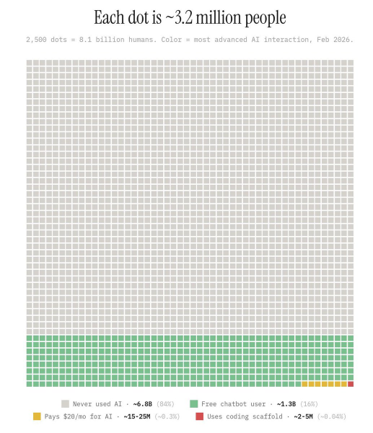
Chart by Damian Player (shared on X, February 2026)
That gap is creating a familiar tension: curiosity paired with overwhelm.
“A lot of people don’t know what they don’t know… there’s so much product innovation happening that it’s hard to keep up. The key is not trying to do everything. Just find what works for your goals and go deep on that.”
-Matt Jensen, Founder, 33 Crickets
The takeaway for community leaders is simple: Don’t chase tools. Anchor to outcomes.
Start Small and Intentionally
Across the board, panelists emphasized that meaningful AI adoption doesn’t require massive investment or technical expertise.
The most effective early use cases were surprisingly grounded:
- Editing and refining content (not replacing it)
- Synthesizing community conversations into insights
- Identifying advocates and high-value members
- Automating repetitive workflows
Notably, many community professionals are resisting fully AI-generated content in favor of augmentation.
“People don’t want AI to do the writing for them. They want to write and then use AI to refine tone, clarity, and structure.”
-Nicole Saunders, Senior Director of Customer Experience Strategy, Higher Logic
That distinction matters. It reinforces a broader pattern: AI works best as a collaborator, not a creator-in-chief.
Saunders also shared an example from Glean, where a community manager with no coding background used a combination of AI tools, including Claude, ChatGPT, and a widget builder, to redesign an entire community experience in just a couple of weeks. What previously would have required coordination between developers, designers, and implementation teams became an accessible, AI-assisted workflow led by a single practitioner, illustrating how small, practical experimentation can quickly evolve into transformative operational impact.
The Real Shift: From Content to Connection
If there was one throughline across the conversation, it’s this:
AI is exposing which parts of community management were never the real job to begin with, and in doing so, it’s reshaping what the role prioritizes.
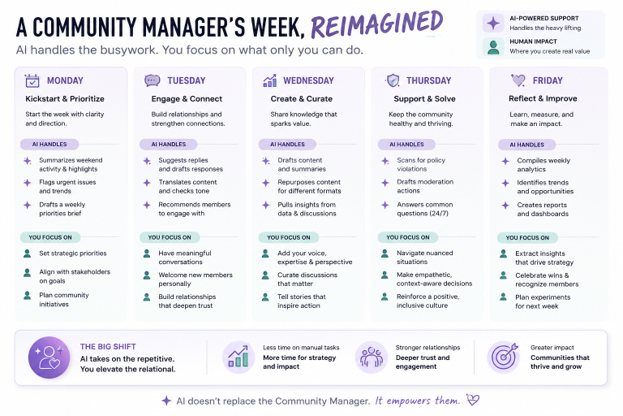
By offloading administrative and repetitive tasks, community leaders are gaining something far more valuable, time to focus on human connection.
“AI can handle the busy work. But community managers become the bridge between technology and members, and between members and the business.”
-Tzufit Herling, Community Consultant, Connecteur
This evolution is already happening. The role is moving from moderation to facilitation, content production to curation, and reporting activity to delivering insight.
Nicole Saunders shared a telling example of an organization that replaced its senior community leader with several junior operational hires after assuming the work primarily required more moderation and administrative capacity. Less than two years later, the company reinstated a senior Head of Community role after realizing that while tasks were being completed, no one was driving strategy, connecting community efforts to broader business goals, or orchestrating the overall member experience.
The lesson was clear: as AI and automation absorb more operational work, the strategic and relational dimensions of community leadership become even more essential, not less.
Rethinking Value in the Age of AI
One of the most important shifts discussed was how community teams communicate their value internally.
Traditional metrics like engagement rates or daily active users are becoming less persuasive in isolation. Instead, leaders are being pushed to tie community efforts directly to business outcomes like customer retention, product feedback loops, advocacy, referrals, and peer-to-peer problem solving.
AI accelerates this shift by making it easier to extract and operationalize community intelligence.
“One of the things that I’ve really been working on this week is proving out this idea that we can use AI to read through community conversations and help us draw insights out of it. So, the first experiment I’ve been running is helping to identify potential customer advocates. So, looking for customers who are sharing successful use cases, interesting use cases, positive quotes, that kind of thing, cross-referencing that with gong calls, which I’m using Glean to help me look into those and then figuring out, ‘Oh! Here’s 5 or 6 folks that I should invite to become part of our brand advocate program.’” -Nicole Saunders
That’s a higher bar, but also a bigger opportunity.
Human Skills Are Becoming the Differentiator
As AI capabilities expand, the panel surfaced a more philosophical, but very real implication:
The more machines handle execution, the more human skills become the differentiator.
Empathy, judgment, trust, and facilitation aren’t just soft skills anymore. They’re core competencies. And in a world increasingly mediated by AI, they may become premium.
Nevertheless, elevating these soft skills into core competencies involves reevaluating our respective relationships with technology in order to identify a system of working that better serves us. George Siosi built a methodology for intentionally designing your tech stack so every tool, app, and platform works with your cognition, not against it.
The philosophy behind this methodology is the concept of Coherence, the alignment between your digital environment and your actual intentions. The protocol is referred to as the 1-3-5 Rule, a pyramidal constraint for stack design.
Imagine a pyramid with 9 slots, 1 slot for an Anchor tool, 3 for Active tools, and 5 for Support tools.
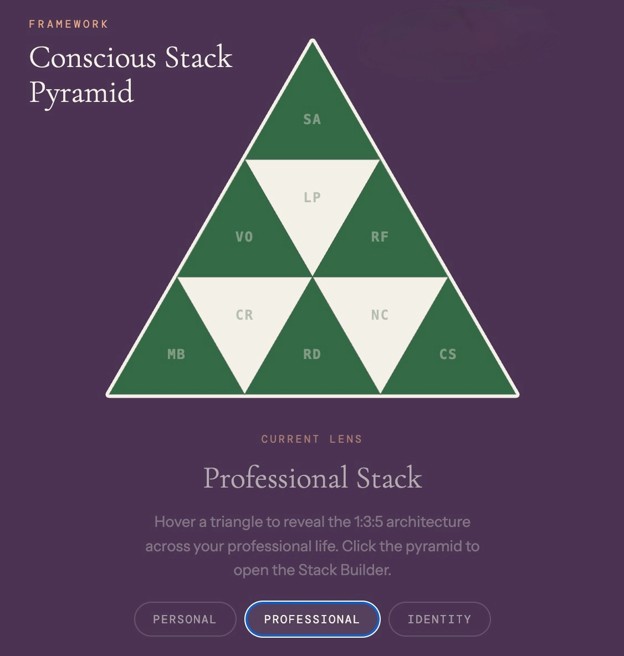
In this context, the 1-3-5 Rule acts as a protective layer for our cognitive load.
“AI is a lot more insidious when it comes to manipulation of behavior. Because we’re using it to chat like a friend, right? But because we’re doing that, it’s getting very good at telling us what we want to hear.
And if you’re not thinking about this consciously, you’re going to think, “Oh, this is amazing!” But you have to also kind of notice when it’s trying to tell you more of what you want to hear and get it to be like, “Hey, can you give me an opposite view just in case or play devil’s advocate?” Because this is where the outsourcing of our cognition, our decision making, and everything goes.
Productivity might start to be less and less important for us…Coherence is actually going to be the thing that’ll be more important for us as the humans dealing with AI.”
-George Siosi, Digital Wayfinder
Still, the conversation wasn’t entirely utopian. As AI increasingly automates moderation, reporting, summarization, and administrative workflows, panelists acknowledged a growing tension inside the profession itself: if community managers spend less time operating communities, what will organizations ultimately expect them to become?
Matt Jensen raised one of the event’s most provocative ideas when he noted that community professionals may increasingly be pushed toward marketing-oriented responsibilities as companies look for clearer business outcomes tied to engagement.
“I hate to bring up this bad word of marketing,” Jensen said, “but a community manager might actually now just become a community marketer.”
The comment resonated because it surfaced a reality many practitioners are already feeling. As AI reduces operational overhead, community leaders may gain more strategic influence, but they may also face greater pressure to connect community efforts directly to growth, retention, advocacy, and revenue outcomes.
The Bottom Line
AI isn’t eliminating the need for community. If anything, it’s reinforcing it.
But it is forcing a shift from doing to designing, managing to leading, and output to impact
For community professionals, the path forward isn’t about mastering every new tool. It’s about clarifying where human value is irreplaceable and doubling down on that.
The real question isn’t whether AI belongs in your community practice. It’s whether you’ve been honest with yourself about which parts of your work are genuinely human — and which parts you’ve just been too busy to hand off. AI is making that distinction unavoidable. And for community professionals who’ve spent years fighting to prove that human connection matters, that’s not a threat. That’s vindication.
Watch the Session
Check out the recording from Practical Community AI Applications with Community Consultants Collective.