
Leading AI Adoption Through Change Management

AI adoption for associations is not just a technology decision. It is a change management challenge that touches staff workflows, member trust, governance, data quality, and organizational culture.
In a recent episode of The Member Engagement Show, Ashleigh A Brookshaw, MA, CSPO,CSM, one of Higher Logic’s strategic advisors, explained what associations need to consider as they move from AI curiosity to AI adoption. Brookshaw brings a multidisciplinary lens to the conversation, combining experience in community strategy, project management, and Prosci-certified change management.
Her core message: Associations should not just start with tools. They should start with the people, processes, and purpose behind the work.
Why AI Adoption for Associations Starts with Change Management
AI is often discussed in terms of tools, features, automation, and productivity. But for associations, the harder work is usually not choosing the technology. It is helping people understand what is changing, why it matters, and how the change affects them.
Brookshaw explained that association leaders need to think about AI adoption at the individual level first, not just rolling out the technology.
“One of my key learnings from Prosci and change management training, is really getting the understanding that change happens at the individual level. Organizations really cannot change unless the people change.”
Brookshaw cautioned associations not to underestimate the people layer.
“When we’re talking about AI adoption specifically, because it is so rapidly evolving and changing, I always caution associations to think through how this could be painful for your members and design a plan to help minimize that friction.”
That point matters because associations are deeply relationship-driven organizations. Staff are often balancing member service, events, education, marketing, volunteer support, and operational demands. Members may have strong feelings about AI depending on their profession, industry, or trust in technology.
AI adoption for associations requires more than a technology rollout plan. It requires a cultural shift. Leaders need to understand where excitement exists, where anxiety exists, and where the organization needs to slow down long enough to build confidence.
Start AI Planning with Member Sentiment and Organizational Context
The right AI strategy will look different for every association. A healthcare association, a trade association, a professional society, and a credentialing organization may all face different member expectations, industry norms, and risk considerations.
That is why Brookshaw recommends starting with assessing the organization’s current state.
“I think one of the most intentional exercises that associations can do, while we’re talking about change at the high level, is take a moment get an understanding of the current state of your organization.”
This landscape includes both internal and external signals. What are members saying about AI? Are they experimenting with it? Are they skeptical? Are there industry regulations, ethical concerns, or public perception issues that should shape the association’s approach?
Brookshaw continued:
“What is the current member sentiment? What are you hearing? What is the industry’s perspective on AI in general? Do you have any data sources to use in your planning? This is where associations have an advantage. They already sit at the center of member conversations. Online communities, surveys, committees, chapters, volunteer groups, and events can all surface how members are thinking about AI. That feedback can help the association decide where to lead, where to educate, and where to proceed with caution.”
Assess Your Organization’s Readiness for Change
Member sentiment is one part of the current-state assessment. Association leaders also need to understand whether the organization is prepared to absorb a new way of working.
A readiness assessment can explore:
- Leadership alignment: Do executives and board leaders understand how AI connects to the association’s mission, strategy, programs, and member needs?
- Staff confidence: Do employees understand how AI may affect their work? Do they have opportunities to ask questions and build the skills they will need?
- Process maturity: Are current workflows documented clearly enough to identify where AI could help and where human judgment remains essential?
- Ownership: Is there a clear person or cross-functional group responsible for AI strategy, implementation, and risk?
- Capacity for change: Do teams have time for training, experimentation, feedback, and process redesign?
Interviews, staff surveys, focus groups, and workflow audits can help leaders identify existing strengths and the areas that need support before implementation begins.
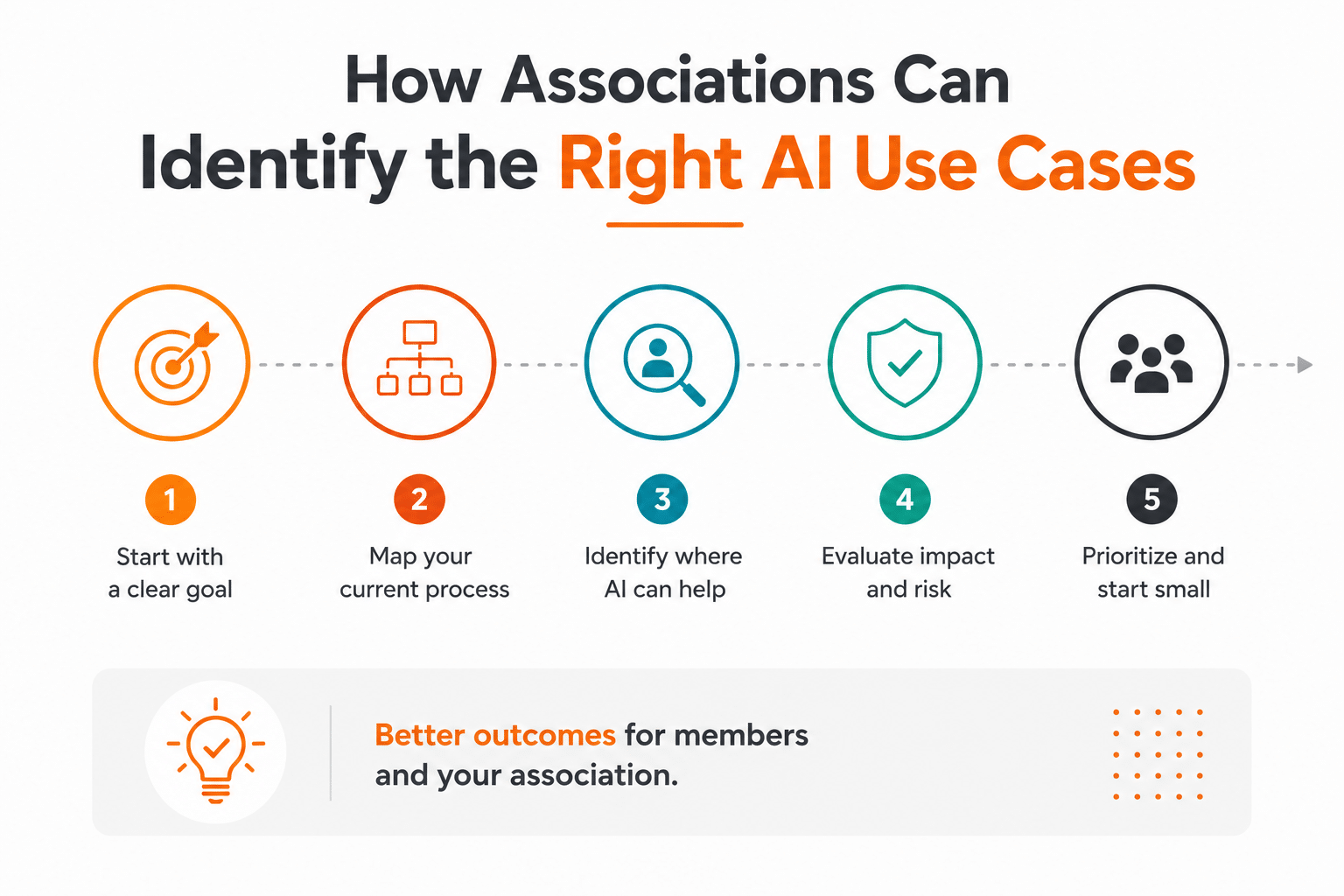
How Associations Can Identify the Right AI Use Cases
One of the biggest challenges with AI adoption is the number of possible use cases. AI can support content creation, customer service, knowledge discovery, data analysis, onboarding, internal documentation, event planning, and more.
The breadth that inspires momentum can also create confusion and decision paralysis.
Brookshaw encouraged associations to think strategically when choosing where AI belongs.
“A lot of people are going, ‘hey, I want to use AI for this,’ but you really should have an answer to the following question: where does AI belong?”
That question should become part of an association’s AI readiness process. Before implementing a tool or AI-powered process, teams should document the workflow they want to improve. What steps are involved? What information does the process rely on? Where is human judgment essential? Where is the task repetitive, time-consuming, or rules-based?
AI can be valuable when it supports a clear goal. But it should not be applied simply because it is available.
Brookshaw framed the decision in practical terms:
“Figuring out where to apply AI involves being intentional and asking yourself, how can this help? And how could it hurt what I’m trying to do? Because there’s inherent risk in everything – both in adopting AI and in not adopting it and potentially missing out on opportunities to save time what would be better used elsewhere or improve your member experience. But you have the power to choose where AI belongs for your organization.”
For association leaders, that risk assessment should include member experience, staff capacity, data privacy, accessibility, bias, accuracy, and reputational trust. The best AI use cases are not always the flashiest. They are the ones that solve real operational problems while preserving the human value members expect from the association.
Why Data Quality Matters Before Associations Implement AI
AI is only as useful as the information it can access and interpret. For associations, that creates an immediate data strategy question: Do you know what data you have, where it lives, and whether it is reliable?
Brookshaw urged associations to examine their current data environment before layering AI on top of it.
“It’s really important to get an understanding of what your organizational and technological infrastructure is as you’re trying to implement AI. You need to understand what you already have and when was the last time your data was cleaned up.”
That question may sound simple, but for many associations, the answer is complicated. Member data may live in an AMS. Marketing engagement data may live in an email platform. Learning data may live in an LMS. Community engagement data may live in an online community. Event data may sit somewhere else entirely.
If those systems are disconnected or inconsistently maintained, AI may amplify the mess instead of solving it.
Brookshaw explained:
“Data cleanliness is probably one of the most highly rated work streams, because whatever you use AI for, it’s only going to be as good as the data that is currently being put into it.”
Data cleanliness is not a glamorous AI workstream, but it is foundational. Associations that want better AI outputs need to invest in better inputs. For association leaders, this means AI planning should happen alongside data governance. Before asking AI to personalize outreach, answer member questions, recommend resources, or summarize engagement patterns, associations need confidence in the underlying data.
AI Governance Requires Cross-Departmental Collaboration
AI governance cannot live in one department. It needs to become an organization-wide way of working. Membership teams understand member records and engagement patterns. Marketing teams understand segmentation, messaging, and campaigns. Education teams understand credentialing, learning pathways, and professional development needs. Community teams understand peer-to-peer behavior and member-generated knowledge. IT understands system architecture and risk.
Brookshaw sees AI as an opportunity to bring these perspectives together.
“This is a great opportunity to have cross-departmental collaboration…you at the association level should get a core team together, a representative from each department and start having that conversation on ‘what kind of data are you tracking and what are we using it for?”
A cross-functional AI working group can help the association answer practical questions: What data are we collecting? Why are we collecting it? Who owns it? What can AI access? What should it not access? What member-facing use cases require additional review?
This kind of governance work also supports adoption. When staff have a voice in shaping AI use, they are more likely to trust the process and understand how it connects to their work.
Turn Governance Into Guidance Staff Can Use
The working group should turn those conversations into clear guidance that staff can apply in their daily work. At a minimum, an association’s AI guidelines should address:
- Approved and prohibited uses of AI
- Which tools may be used with organizational or member information
- How information is classified and what AI tools may access
- When human review and approval are required
- Expectations for accuracy, accessibility, fairness, privacy, and brand alignment
- Who monitors performance and responds when problems arise
- How policies will be reviewed as tools, risks, and regulations change
Governance should make responsible experimentation easier. Pair the policy with approved tools, practical examples, and a clear place for staff to bring questions or propose new use cases.
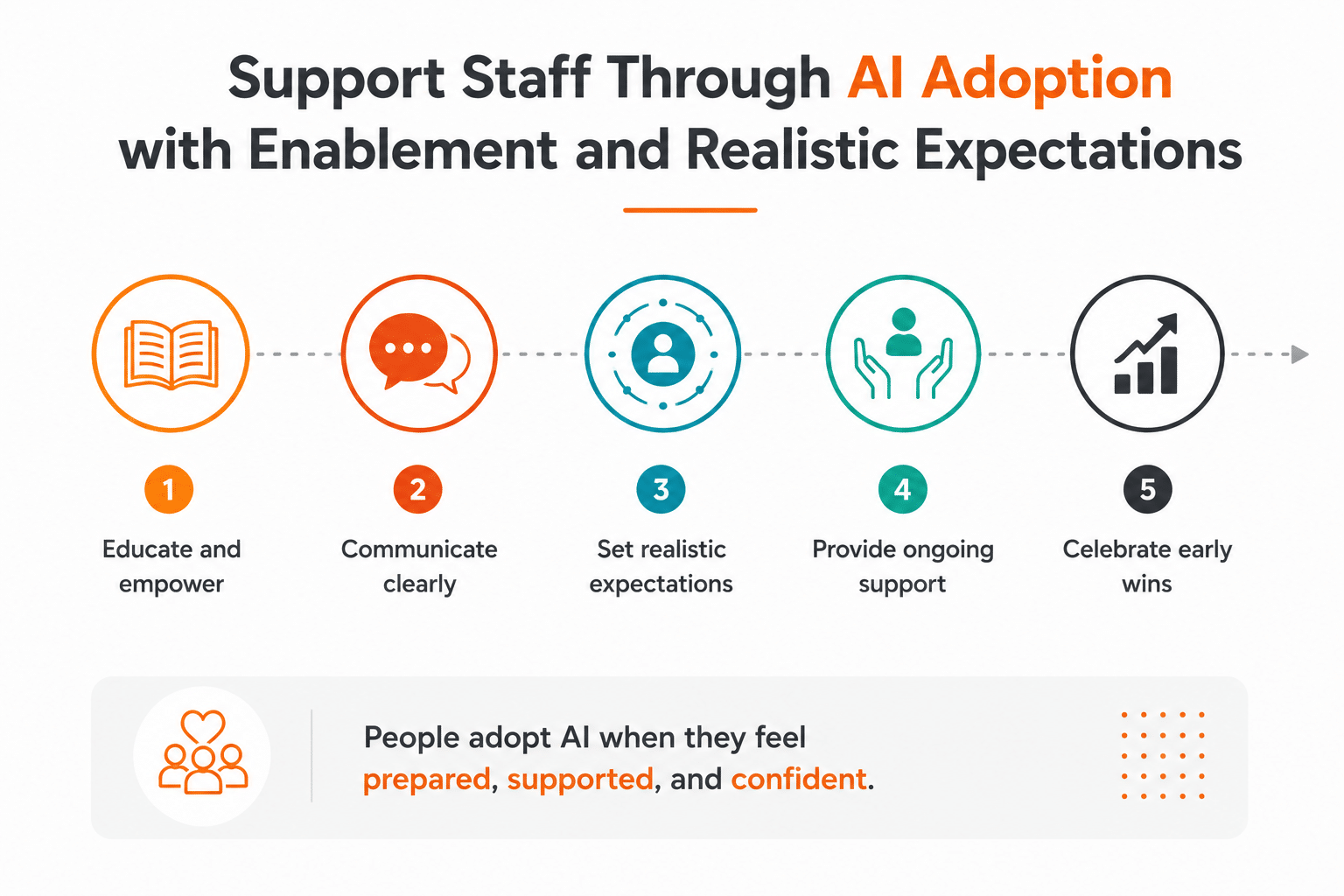
Support Staff Through AI Adoption with Enablement and Realistic Expectations
Association staff are already busy. Any AI adoption plan that ignores staff capacity is likely to create resistance, confusion, or burnout. Leaders should not assume staff can absorb new tools, new policies, new workflows, and new expectations without support.
Brookshaw acknowledged this directly.
“I would be remiss if I didn’t acknowledge that association staff are already strapped for time. At the same time, if AI is really something that your organization is interested in doing and implementing, it does require an investment of time to figure out how you’re going to use AI an organizational level.”
But Brookshaw emphasized that there is no requirement to transform everything at once. A practical way to manage that tension is to start small. A pilot gives the association a lower-risk way to test assumptions, gather feedback, and learn what staff need before expanding.
Pilots can also help staff build confidence. Instead of telling employees to “use AI” broadly, associations can define a narrow use case, clarify expectations, provide training, and create space for staff to compare what is working.
Build Skills for Different Roles and Responsibilities
Organization-wide AI capability will not develop through a single training session. Staff need opportunities to build relevant skills, apply them to real work, and ask questions as tools and policies change.
Training should reflect each role’s responsibilities and level of risk. Depending on how employees use AI, they may need to learn how to:
- Evaluate outputs for accuracy and completeness
- Protect sensitive organizational and member information
- Write clear instructions and provide useful context
- Recognize bias, hallucinations, and unsupported claims
- Apply professional judgment before using or sharing an output
- Escalate questions or incidents to the appropriate person
Formal courses can provide a foundation, but workshops, office hours, peer demonstrations, and shared examples help staff translate general principles into daily practice. Leaders should also make it safe for employees to report concerns and explain where a new process is creating friction.
The Mindset Shift Association Professionals Need for AI
AI adoption requires new skills, but not everyone needs to become a technical builder. For many association professionals, the more important shift is learning how to evaluate AI in context.
Brookshaw described that mindset as curiosity combined with judgment. This approach is useful for associations because curiosity alone can lead to experimentation without direction. Context alone can lead to caution without movement. Together, they help teams ask better questions: How could this help our members? What would need to be true for this to work? What risks do we need to manage? What human review is required?
AI also asks associations to become more comfortable with iteration. Unlike a traditional technology implementation with a fixed launch and stable feature set, AI is changing quickly.
Brookshaw noted:
“It’s helpful to have an understanding that you can be committed to the journey and not necessarily a full end result because AI evolves so rapidly. We don’t know what the end result could be. There is no kind of like defined end.”
That is a helpful reframing for association leaders. You do not need to know exactly what AI will look like five years from now to begin building responsible practices today.
The goal is not to chase every new tool. The goal is to build organizational habits that make thoughtful adoption possible: curiosity, documentation, experimentation, feedback, governance, and human judgment.
Keep AI Human-Centered, Ethical, and Aligned to the Association Mission
Associations are trusted because they represent communities of people. That trust should shape every AI decision.
Brookshaw emphasized the importance of keeping people involved in the process.
“It’s really important to build in human-centered feedback loops and make sure you’re approaching things ethically and responsibly.”
Human-centered AI means members and staff should understand how AI is being used, when human review is involved, and where they can provide feedback. It also means associations should be transparent about AI’s role in member-facing experiences.
Brookshaw reminded listeners that AI is not the decision-maker. It is a tool.
“It is a tool, and how we leverage that tool is up to us. So when we’re talking about positioning AI related to your organization, approach it with an understanding of your mission, vision, and values as an organization, because those may influence how you approach it.”
That distinction matters. Associations should not allow AI adoption to drift away from what they care about and who they support. Before using AI in a new process, leaders should ask whether the use case supports the organization’s purpose.
An association’s AI principles do not need to be overly complicated. They should clarify what the organization will use AI for, what it will not use AI for, how member data will be protected, and where human oversight is required.
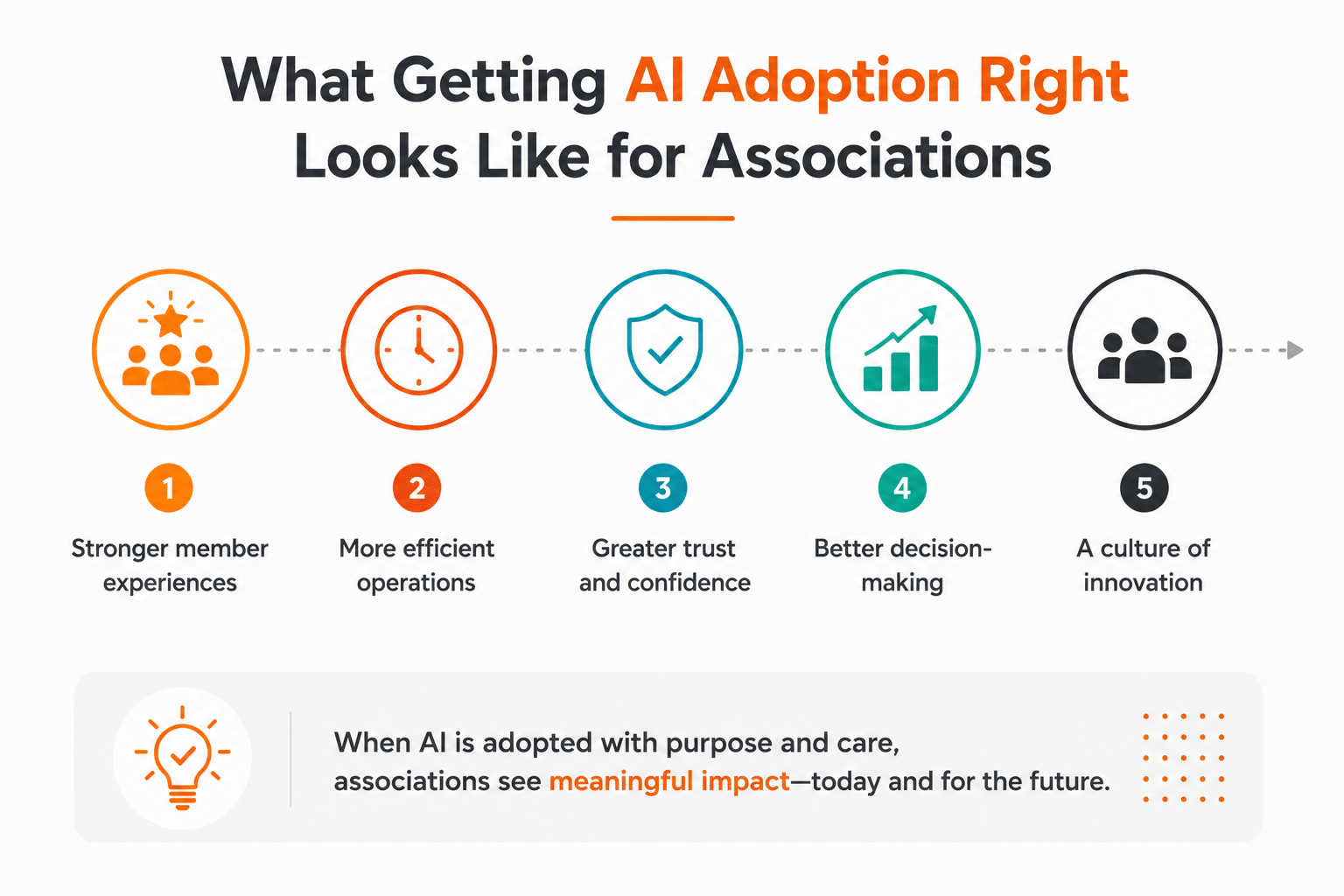
What Getting AI Adoption Right Looks Like for Associations
There is no single definition of AI maturity that will fit every association. A small staff association may use AI to reduce repetitive administrative work. A larger organization may use AI to improve knowledge discovery, personalize content, support member onboarding, or analyze engagement trends.
Brookshaw said the definition of success depends on the organization.
“When I think through what the definition of ‘done or right’ is, it’s going to look different at like every organization. Through that lens, what I hope associations ‘get right,’ it’s really that they see a positive impact from AI. Did it improve a process? Did it make a make a difference from like the member perspective? You’re not pursuing AI for AI’s sake, you’re doing it to improve.”
The success of your AI efforts should be measured by whether they help the association accomplish something meaningful. Did it improve a process? Did it help staff focus on higher-value work? Did it make resources easier for members to find? Did it support a better member experience?
That is the right test for associations. AI adoption should not be pursued for its own sake. It should help the organization operate with more clarity, deliver value more effectively, and preserve the trust members place in the association.
AI Adoption Checklist for Association Leaders
For associations beginning or refining their AI adoption strategy, the work does not need to start with a major transformation. It can start with a focused review of readiness, purpose, and governance.
Consider these steps:
-
Assess member and industry sentiment toward AI. Use surveys, community conversations, committee feedback, and event discussions to understand where members are curious, concerned, or already experimenting.
-
Evaluate organizational readiness. Review leadership alignment, staff confidence, process maturity, ownership, and the organization’s capacity for change.
-
Audit current processes before selecting tools. Document how priority workflows operate, where staff lose time, and where AI could support a meaningful outcome.
-
Review data quality and system connectivity. Identify where member, marketing, education, event, and community data live and whether those sources are clean, current, and usable.
-
Create a cross-functional AI working group. Include people who understand member experience, communications, education, technology, operations, privacy, and the information AI may use.
-
Establish practical AI guidelines. Define approved tools and uses, data boundaries, human review requirements, accountability, and a process for updating the guidance.
-
Build staff capability. Provide role-based learning, opportunities to practice, and a clear place to raise questions or report problems.
-
Run a focused pilot before scaling. Choose one use case, establish guardrails and success measures, gather feedback, and use the results to decide what happens next.
AI Adoption Is a Leadership Practice
All associations do not need to adopt AI in the same way or at the same pace. But they do need to approach it intentionally.
The organizations that make the strongest progress will be the ones that treat AI as part of a broader leadership practice: understanding member needs, preparing staff, strengthening data foundations, creating governance, and staying anchored to mission.
AI can help associations work differently. But the change will only last if people understand why it matters, how it supports them, and how it helps the association deliver more value to members.
For more conversations on association technology, member engagement, and digital strategy, listen to The Member Engagement Show from Higher Logic.