


AI Will Change the Role of the Community Manager: A Shift from Doing to Designing
Explore how community managers are shifting from task execution to workflow design, governance, AI guardrails, customer context integration, and measuring community impact in an AI-driven world.

As Senior Director of CX Strategy at Higher Logic, Nicole Saunders hosts an ongoing AI study group for community professionals. These conversations have been valuable in helping the group move past the hype and into the practical questions: What is actually changing? What do community teams need to understand? Where are the risks? Where are the opportunities?
In the latest conversation, the focus was on MCPs and how using them will fundamentally change workflows. The topic can sound technical at first, but the underlying shift is very relevant for community teams. AI is not just changing what tools can do, it is changing what community managers need to be able to design, define, and explain to stakeholders. Here are some of the insights that came out of that meetup:
For a long time, community management has involved a lot of doing. Community managers read through new posts, welcome new members, answer questions, route issues, review flagged content, identify trends, create reports, and try to connect what is happening in the community to what the business cares about.
AI is starting to change that. Not because all of that work disappears, but because more of the execution can be assisted, accelerated, or partially automated.
This creates an important shift in what the role of the community manager is. If AI can help do more of the routine and administrative work, the human’s role becomes more focused on designing how the work should happen. That means defining the workflow, identifying the right data sources, setting the guardrails, and deciding what a good outcome looks like.
That may sound like a small change, but I think it is a meaningful one. Community managers will increasingly need to understand not only how to run a community, but how to translate community operations into instructions that AI can follow safely and usefully.
MCPs Will Enable Community Managers to Efficiently Connect Context
One of the biggest challenges in community work has always been that the most useful information is often spread across different systems.
A community manager may need to look in the community platform to understand what a customer is asking, in a CRM to understand the account relationship, in a learning system to see whether they have completed training, and in marketing or support systems to understand the broader customer journey.
Historically, bringing all of that together required custom integrations, dashboards, or a lot of manual work. Oftentimes this has meant that the work of helping and engaging with a customer happened without the full context, or by putting the burden on the customer to provide that information – even though it has already been shared and tracked in the business’ systems – over and over again.
MCP matters because it creates a way for AI tools to access and understand different systems through a more common structure. In practical terms, this means a community question does not have to stay isolated from the rest of the customer context.
For example, instead of simply seeing that a new member joined the community, an AI-enabled workflow could help identify what company they are from, what role they have, what training they have completed, what they clicked on first, and what kind of welcome message might actually be useful to them. The community manager can better answer a user, provide resources specific to them, and avoid sending them back to something they’ve already tried.
The Community Manager’s Skills Become Workflow Design
Whenever beginning to bring AI into a workflow, you must answer three basic questions: What should the AI know? What should it do? What should it never do?
That framework is especially important in community because so much of the work involves judgment, i.e. drafting a response is different from posting a response; identifying a moderation issue is different from deleting content; recommending that a customer success manager be alerted is different from escalating something automatically.
This is where community managers bring real expertise. They understand the norms of the space, the tone that will work with members, the difference between a frustrated customer and an abusive one, and the places where human review is still necessary.
AI can help with the work and recommending actions, but it needs community professionals to define the rules of engagement and ensure the work is executed within the proper context.
Guardrails Are Not Optional
The more connected AI becomes, the more important governance becomes.
If an AI tool can read community content, that raises questions about privacy and permissions. If it can write to the community, that raises questions about approval and accountability, not to mention the . If it can take moderation action, that raises questions about audit trails, reversibility, and human oversight.
This is not a reason to avoid AI. It is a reason to be thoughtful about implementation.
For most community teams, the safest starting point will likely be using AI to analyze, summarize, draft, and recommend, while keeping publishing, moderation, deletion, and member-impacting actions under human control. Over time, some organizations may become comfortable automating more, but those decisions need to be made deliberately.
The companies that succeed with AI in community will not be the ones that simply turn everything on. They will be the ones that understand their workflows well enough to decide where AI should help, where humans need to stay involved, and where the risks are too high.
AI Will Mature Community Measurement
AI also raises important questions about community value.
For years, community teams have been encouraged to move beyond activity metrics, and AI makes that shift even more urgent. Traffic, views, posts, and replies may become less meaningful as search behavior changes, AI-generated content increases, and more users get answers without visiting a forum directly.
At the same time, AI will make it easier to connect community activity to business outcomes.
If community data can be understood alongside account health, product usage, support history, and learning activity, teams can begin to ask better questions. Which accounts are showing signs of frustration? Which members are becoming advocates? Which unanswered questions point to documentation gaps? Which topics are increasing in urgency across a customer base?
That is a much more valuable conversation than simply reporting how many posts were created last month.
Community Managers Will Need New Skills
I do not think AI makes community managers less important. I think it changes what the most valuable community managers will need to be skilled at.
They will need to understand how to design workflows, write clear instructions, define outcomes, evaluate AI-generated recommendations, and create guardrails. They will need to know enough about connected systems to ask better questions, even if they are not the people building the technical infrastructure.
Most importantly, they will need to bring the judgment that AI does not have. Community work has always required context, nuance, and an understanding of people. Those things become more important, not less, when AI is introduced into the workflow.
There is still a lot to figure out. MCP, AI skills, and agent-driven workflows are still evolving, and many organizations are just beginning to understand what these tools will mean in practice.
But I think one thing is clear: the next phase of AI in community will not just be about automating tasks. It will be about designing better systems for connecting people, information, and business outcomes. Community teams that learn how to do that well will be in a much stronger position to show the value of their work.
Related Resources
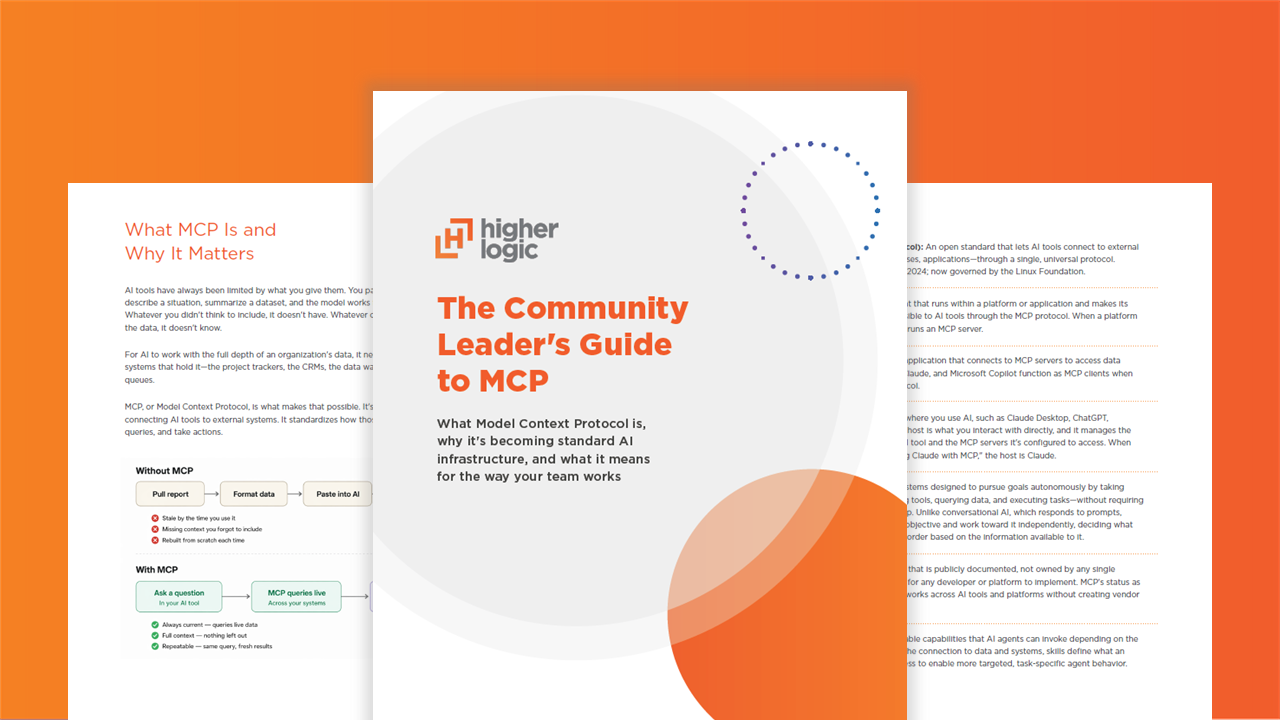
The Community Leader’s Guide to MCP
Discover what MCP (Model Context Protocol) is, why it’s becoming standard AI infrastructure, and what it means for the way...
Read More
How AI Is Changing the Way Community Teams Work: An Introduction to MCP
Learn how MCP connects AI tools to community data to answer questions, take action, surface insights, and automate tasks.
Read More