
7 Common Challenges Associations Face With an Outdated LMS

Education has always been a core part of an association’s value. But how that education is delivered varies widely.
Some associations rely on an outdated learning management system (LMS). Others don’t have an LMS at all—using one-off webinars, shared drives, spreadsheets, or third-party tools to piece together their education programs.
While these approaches may work in the short term, they often create hidden challenges as member expectations grow and education programs expand. Over time, the lack of a modern, purpose-built LMS can limit engagement, strain staff resources, and make it harder to scale learning in a sustainable way.
Here are some of the most common challenges associations face when they don’t have a modern LMS, or are managing education without one entirely.

Member Engagement Starts to Slip
When associations don’t have an LMS, or rely on basic or outdated learning tools, member engagement is often one of the first things to suffer. Courses are harder to find. Navigation isn’t intuitive. The experience feels transactional instead of valuable.
Over time, this leads to lower course completion rates and less repeat participation in education programs. Members may still value learning, but the platform itself becomes a barrier instead of an enabler.
A modern association LMS is designed with the learner experience in mind, making it easier for members to discover content that’s relevant to them and engage on an ongoing basis.
Continuing Education Becomes Hard to Scale
Many associations begin delivering education without a formal LMS, using webinars or manual processes to meet immediate needs. That approach can work early on—but as programs grow, it quickly becomes difficult to scale without a centralized learning platform.
As demand grows, cracks begin to show:
- Launching new courses takes longer than it should
- Updates require workarounds or outside help
- Organization and planning becomes more difficult
- Systems struggle to keep up with increased usage
Without a scalable LMS, expanding continuing education programs can feel like adding stress instead of value.

Staff Spend Too Much Time Managing the System
One of the most common pain points for associations without an LMS or using a legacy LMS platform is administrative burden.
Managing education often means staff have to juggle spreadsheets, manual uploads, disconnected reporting tools, email confirmations, separate reporting systems, and duplicate data entry just to keep programs running. Simple tasks—like pulling completion reports or updating course information—take far longer than they should. With all of this being such a manual process, it’s easy for information to become outdated, inaccurate, or not timely.
A modern learning management system for associations reduces this overhead through automation and integration, allowing teams to focus on improving programs rather than maintaining them.
Certifications and Credentials Are Difficult to Manage
For many associations, certifications and credentials are mission-critical. Without an LMS designed for credentialing—or any LMS at all, certification tracking is frequently handled manually, increasing the risk of errors and inconsistencies.
Tracking credits manually, maintaining accurate learner records, and supporting renewals or expirations can strain both staff and members. The result is frustration on both sides—and increased risk when it comes to compliance or accreditation requirements.
Modern LMS platforms are built to support certification workflows from end to end, with automated tracking, digital credentials, and reporting that’s actually usable.
Education Revenue Is Harder to Grow
Education is one of the most reliable sources of non-dues revenue for associations—but only when it’s easy to package, price, and promote.
Without a modern LMS, associations may struggle to:
- Offer member vs. non-member pricing
- Bundle courses into learning paths or programs
- Quickly launch new revenue-generating offerings
Over time, this limits growth and makes it harder to respond to changing member needs.

Limited Insight into What’s Working (and What Isn’t)
When educational programs are delivered across multiple tools—or managed without an LMS entirely—meaningful reporting becomes difficult or impossible. This makes it difficult for associations to make informed decisions.
Associations often lack clear visibility into which courses perform well, where learners disengage, or how education ties back to retention and membership growth. That makes it harder to justify investment—or improve results.
A modern LMS provides clear, actionable insights that help associations refine their education strategy over time.
Learning Feels Disconnected from the Member Experience
When learning exists in its own silo, members feel that separation. Without a centralized learning platform, education often exists outside the core member experience, disconnected from community discussions, events, and ongoing engagement.
Education that doesn’t connect to community discussions, events, or other engagement opportunities leads to missing value and connection.
For associations focused on long-term engagement, learning shouldn’t stand alone. It should be part of a connected experience that supports professional growth and community participation.
Time to Reflect: “Do I Need an LMS?”
You may be ready for a learning management system if:
- Education is managed through webinars, shared files, or spreadsheets
- Tracking completions, credits, or certificates is manual
- Members struggle to find or navigate learning content
- Staff spend too much time administering education programs
- You want to scale education or grow non-dues revenue
For associations without an LMS, or those outgrowing an older system, a modern platform can turn education into a scalable, connected member experience.
How Higher Logic Thrive Learn Helps Associations Move Forward
Whether an association is replacing a legacy LMS or formalizing education for the first time, Higher Logic Thrive Learn is built to support modern association learning programs.
It helps organizations:
- Deliver engaging, learner-friendly education experiences
- Scale continuing education and certification programs with confidence
- Reduce administrative workload through automation and integrations
- Generate non-dues revenue from education
- Connect learning with community, marketing, and member data
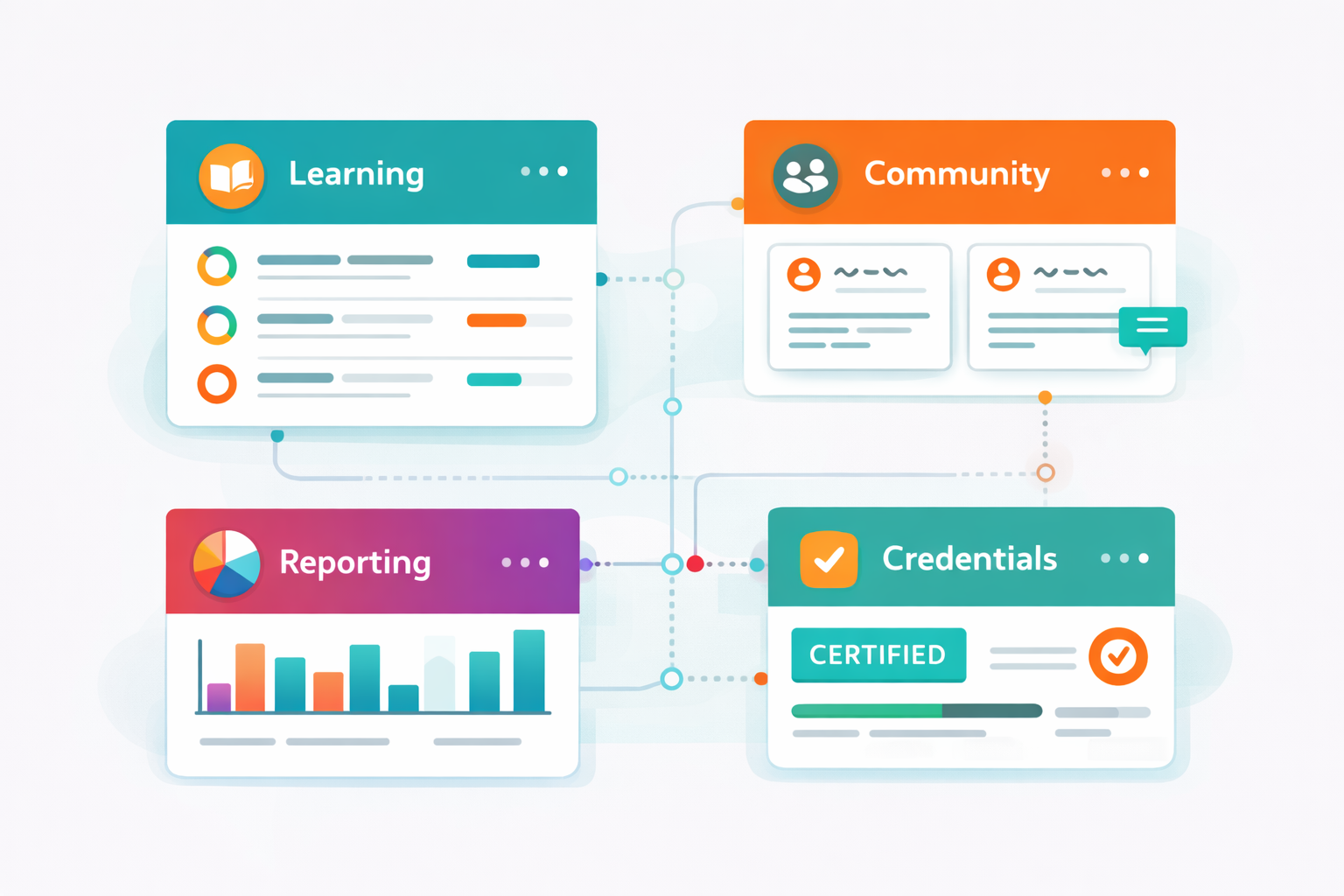
Instead of treating education as a standalone system, Thrive Learn brings it into the broader engagement ecosystem, helping associations create more value for members and more impact for their organization.
Is Your LMS Supporting—or Holding Back—Your Education Strategy?
For associations managing education without an LMS today, the right platform can turn manual processes into scalable programs—without losing flexibility or control.
Or, if delivering great learning while managing your current LMS feels hard , that’s a sign something isn’t working.
Modern association learning platforms are designed to support growth, engagement, and efficiency—not add complexity. With the right LMS in place, education becomes a strategic advantage instead of a constant challenge.
Learn how Higher Logic Thrive Learn supports modern association education.
Frequently Asked Questions (FAQ)
An LMS for associations is a learning management system designed to support member education, continuing education, and certification programs. Unlike corporate LMS platforms, association LMS software integrates with member data, supports credentialing, and helps generate non-dues revenue from online learning.
Associations need a modern LMS to deliver engaging online learning, scale education programs, and reduce administrative workload. Modern LMS platforms also provide better reporting, automation, and integration with AMS and community platforms, improving both the member experience and operational efficiency.
Legacy LMS platforms often create challenges such as low learner engagement, manual administrative processes, limited reporting, and poor support for certifications. These systems can also make it difficult to scale continuing education programs or connect learning to the broader member experience.
A modern LMS improves engagement by making learning easier to find, more personalized, and better integrated with other member experiences. Features like intuitive navigation, learning paths, and community integration help members stay involved and continue learning over time.
An LMS supports continuing education by tracking course completions, credits, and certifications automatically. Modern systems simplify credential management, renewals, and reporting, helping associations maintain compliance while reducing manual work for staff.
Higher Logic Thrive Learn is built specifically for associations and nonprofits. It supports continuing education, certifications, and online learning while integrating with community and marketing tools. This allows associations to deliver connected learning experiences and turn education into a strategic growth driver.