
2026 Association Community Benchmarks: Five Findings Worth a Closer Look

It’s here. The 2026 Association Community Benchmark Report is finally finished, and it is a big one.
As the report’s primary orchestrator, I’m proud of how much we packed into it. We looked at anonymized community data from approximately 1,200 associations and nonprofits, covering June 2025 through May 2026. There are benchmarks, graphs, practical recommendations, and plenty of opportunities to say, “Hmm. Maybe we should try that.”
You do not have to read it cover to cover. Jump to the graphs you’re most interested in. Compare communities of a similar size. Investigate the tactic you’ve been trying to get buy-in for. I want this report to be useful to you, even if you only spend ten minutes with it.
Here are five findings I’d put on your radar.
Want ALL the Data? Get the Full Report.
The post below summarizes some highlights, but if you want to dig deeper, download the full 2026 Association Community Benchmark Report. Your next idea—or the data to help get it approved—might be waiting inside.
1. Community Engagement Is Holding Steady.
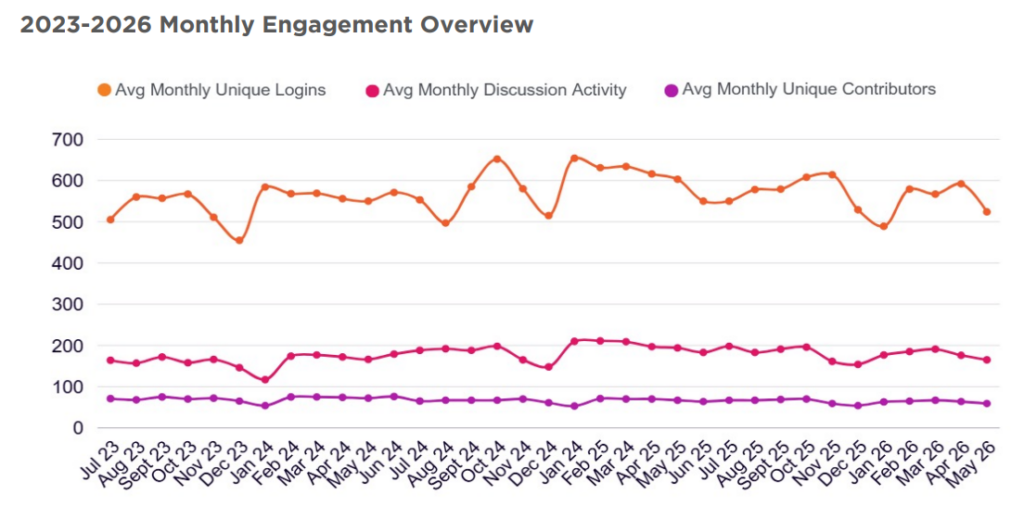
Looking back at our community benchmark data from previous years, community engagement levels have been sitting around the same numbers since at least 2023.
I find that encouraging, in the context of the declining website traffic many organizations are seeing because AI chatbots are siphoning people away from organic search.
And the fact that community has stayed strong makes sense to me. So much of what we encounter online is content to consume. People also want somewhere to ask a question, compare experiences, and hear from another person who understands their work.
Yes, I appreciate the irony of making this point in a content marketing blog. Content has its place. I write reports, guides, and blog posts every year, so clearly I believe in the value of high-quality content. But a useful article and a conversation with a peer meet different needs. Associations can offer both.
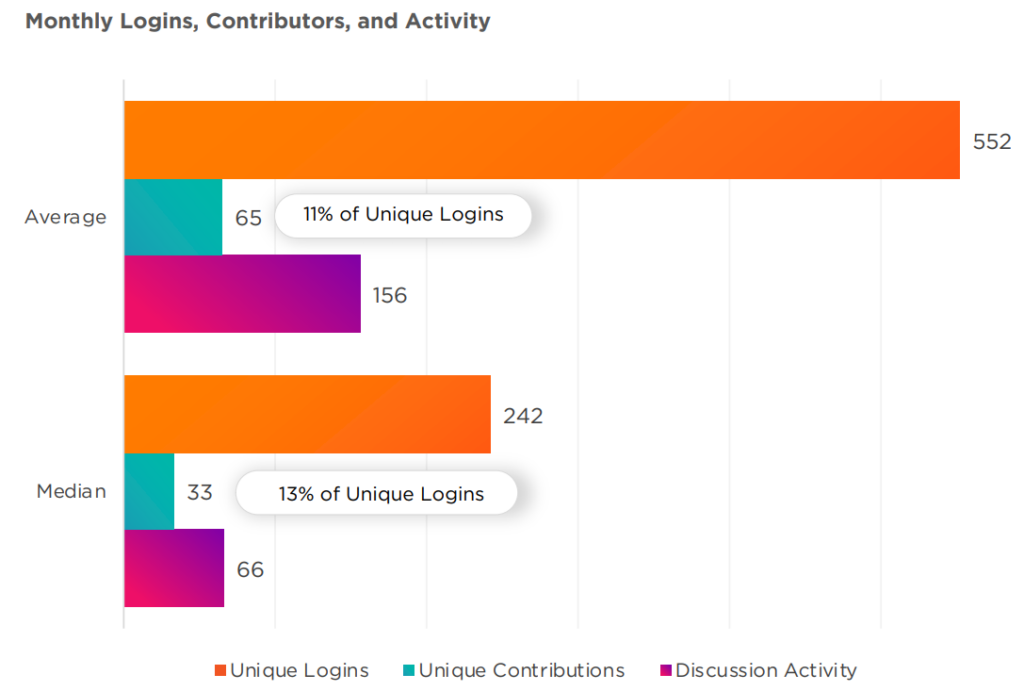
In terms of this year’s numbers:
- Communities averaged 552 monthly unique logins, 65 contributors, and 156 discussion actions.
- The median was 242 monthly unique logins, 33 unique contributors, and 66 discussion actions.
One thing to remember when you’re benchmarking your online community: the averages you find in any benchmark report aren’t supposed to be a universal target. You can use them for guidance but ultimately you should be measuring against yourself: are your numbers improving or declining? Which activities seems to stand out in terms of engagement?
In the 2026 Association Community Benchmark Report, you’ll notice that the average community activity is vastly different than the median. That’s because we have communities in our data set with 200 members vs. 200,000. We have communities that just kicked off, and communities that have been around since Higher Logic started in 2007.
When you download the full report you can use the report’s size and age comparisons to put your own numbers in context with segments that are similar to your organization.
2. Your Community Digests Deserve Some Credit
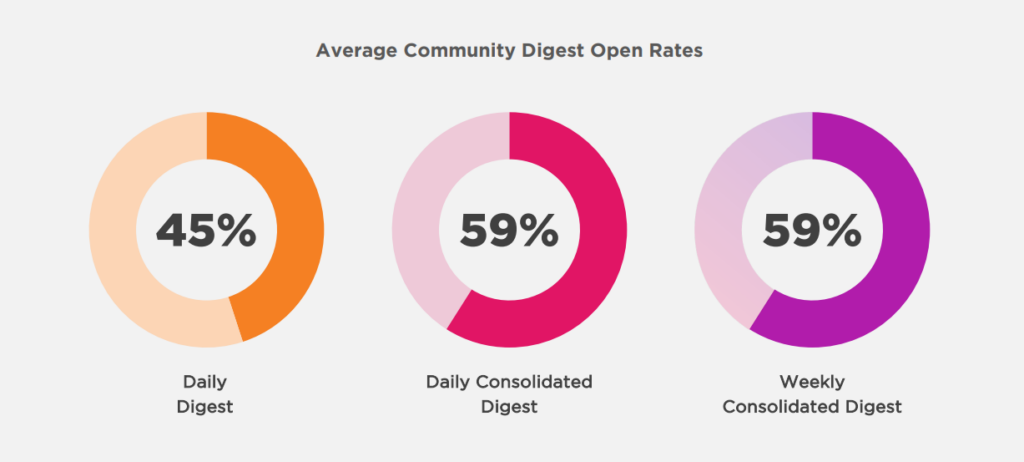
Daily consolidated and weekly consolidated community digests both averaged 59% open rates. Standard daily digests averaged 45%.
Community managers, this might be a good graph to share with your marketing colleagues. When I worked as a marketer for associations, our typical emails never broke a 30% open rate so a 59% open is pretty impressive and it’s a good reminder that the community’s value extends beyond people logging in.
Digests put peer questions, replies, and resources directly into members’ inboxes. They give people a way to stay connected to the community even when logging in isn’t on today’s to-do list.
The daily and weekly consolidated formats had the same average open rate, which is a useful reminder to give members options. Someone who prefers a weekly digest can still stay interested in what their peers are discussing.
3. AI-Supported Discovery Is Worth Watching
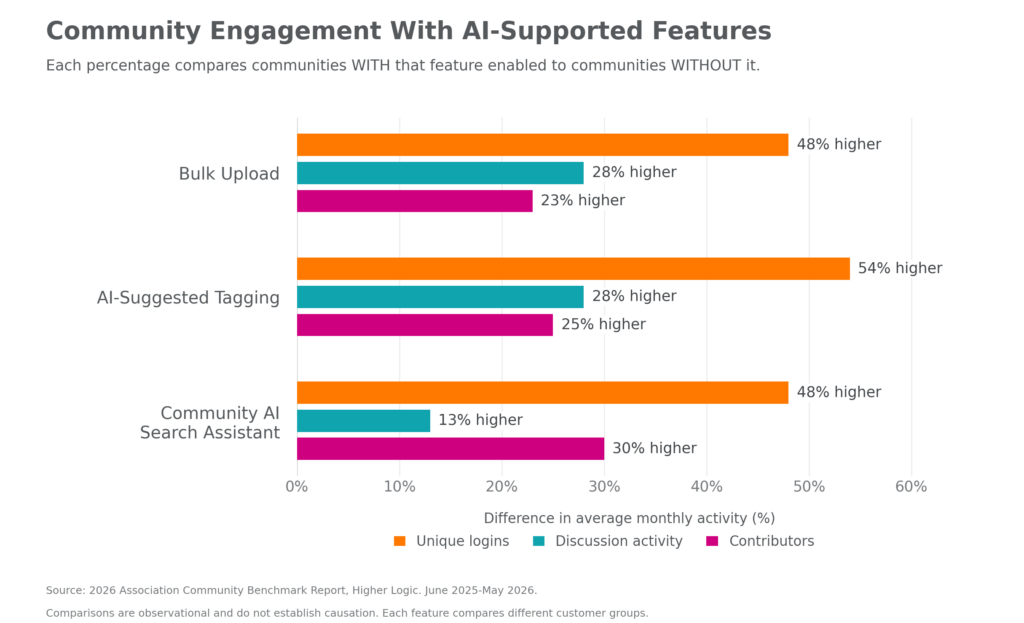
Communities in our data set with the Community AI Search Assistant enabled averaged about 48% more monthly unique logins than those without it. Communities with AI-suggested tagging enabled averaged approximately 54% more. The graph above summarizes the differences but you can check out the individual comparisons in the full report.
Those are findings I’d bring to any conversations where you’re talking about making your associations knowledge easier to find.
Your members may have years of helpful discussions and resources available to them. That knowledge becomes much more useful when they can find the answer they need without knowing where someone filed it.
One caveat applies here and to the feature comparisons below: these comparisons show correlation, not proof of cause and effect. Community size, age, staffing, product package, and investment may also help explain the differences. “Enabled” also doesn’t necessarily mean a feature was used frequently.
Still, if finding information is a recurring frustration for your members, the report gives you a reason to investigate AI-supported search and content organization. People supply the expertise. Technology can help more members reach it.
4. Chapters, Volunteers, and Other Member Experiences Belong in the Community
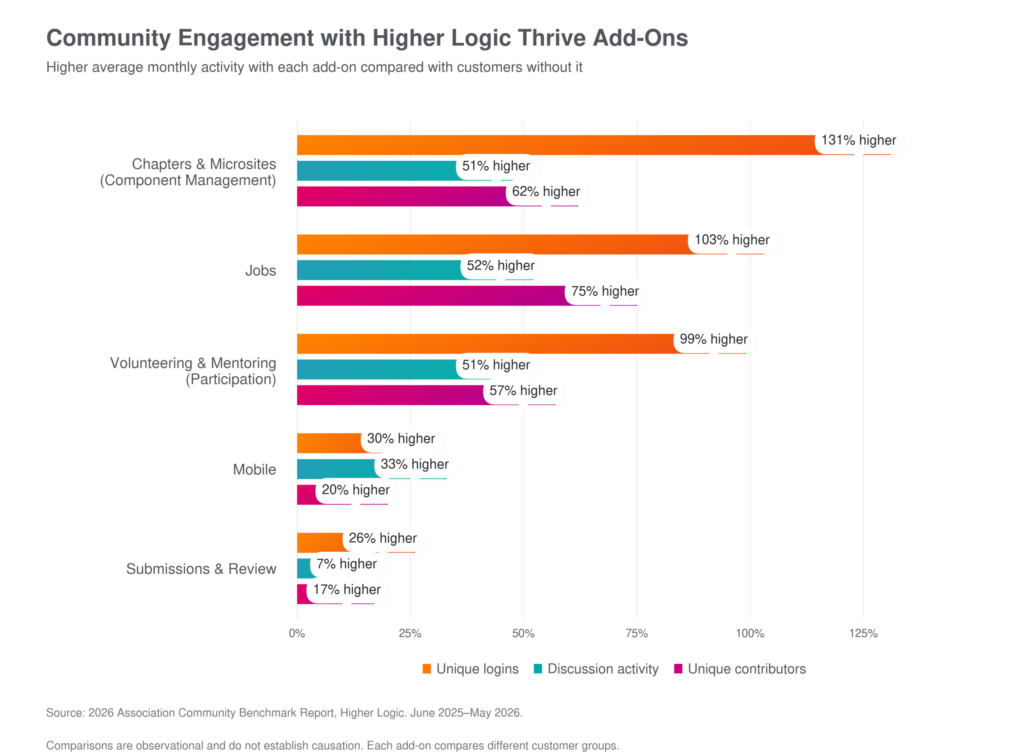
This was one of my favorite patterns in the report: communities connected to other programs show higher engagement.
We can measure this by looking at the performance of communities with one of Higher Logic Thrive’s add-ons vs. those without them. When we looked at communities that incorporated chapters and microsites, job boards, volunteering and mentoring, mobile access, and submissions and review, all showed higher average logins, discussion activity, and contributors. A few highlights:
- Communities with Jobs averaged 103% more monthly unique logins
- Communities with Volunteering and Mentoring averaged 99% more monthly unique logins.
- Communities with Mobile access recorded 33% more discussion activity
- Communities with Submissions and Review averaged 17% more contributors.
These comparisons don’t prove that an add-on caused the difference, but they give us insights into the way connecting your member experience supports deeper engagement.
Each member might have different reasons to get involved. Someone might come looking for a job, join a mentoring program, or participate in their chapter. Your members also see your association as one entity, not as the separate programs that may be run by different departments internally. That’s why connecting the different benefits members might want to use is so important. Giving members one place, like the community, where they can find and engage with everything creates ease of access and gives them more visibility into the opportunities available to them, and the connections that come with those opportunities.
If you’ve been trying to get your association’s programs to work more closely together, this is a graph worth bringing to the meeting. Start with an experience your members already value, then ask how community could make it easier to participate, connect, or keep the conversation going.
5. Automated Recognition of Member Engagement is Worth It
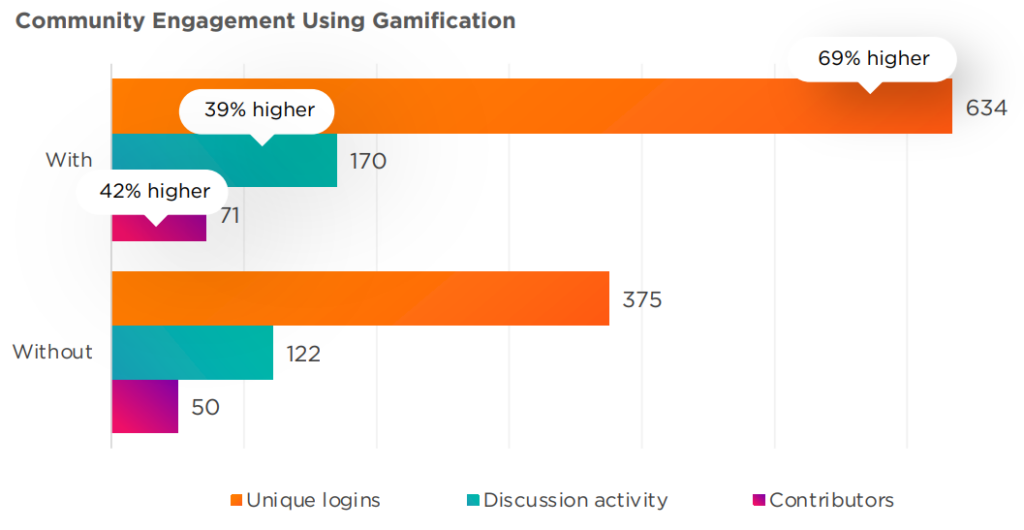
Communities with gamification enabled averaged 69% more monthly unique logins, 39% more discussion activity, and 42% more contributors than those without it.
Recognition doesn’t have to mean turning your community into an elaborate competition. A ribbon or badge can acknowledge a helpful answer, celebrate a first contribution, or recognize someone who gives their time to other members.
The question I’d start with is: what contributions do we want members to know we appreciate?
Choose something meaningful, make the recognition clear, and watch how members respond. If you need inspiration, these online community engagement ideas offer more places to start.
Give Your Community Something to Grow On
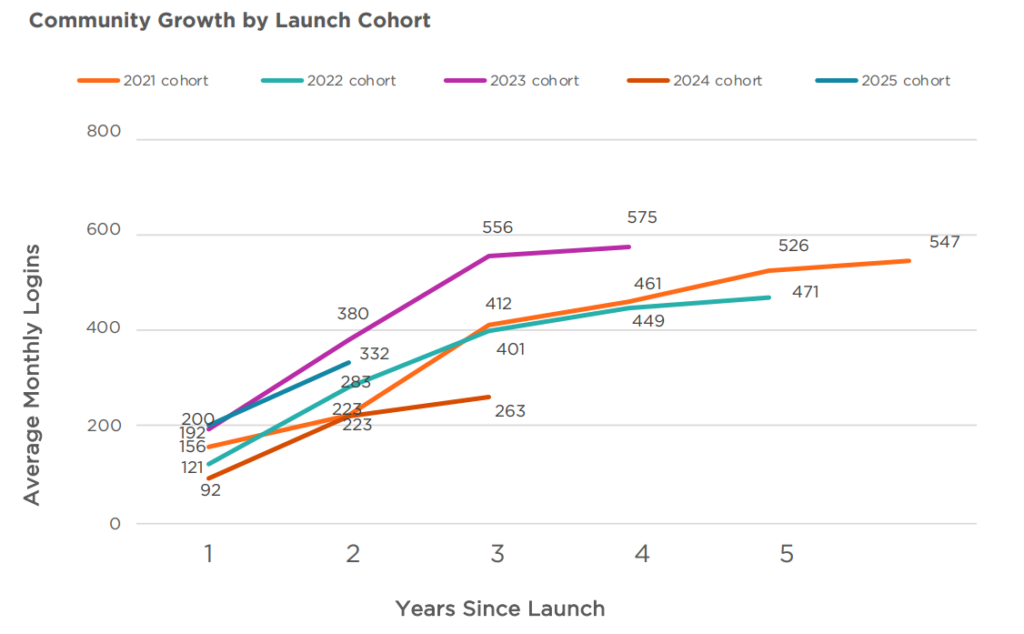
One more graph I want you to see before you go: across the launch cohorts in this report, average monthly logins increased as communities matured. Growth looked different for each group, but the direction was consistent.
That’s encouraging if you’re putting in the work and wondering when you’ll see more momentum. Communities need time for members to build relationships, develop habits, and discover what’s useful. Thoughtful onboarding, relevant conversations, helpful resources, and recognition give them reasons to keep coming back.
Time alone isn’t an engagement strategy, of course. But this graph gives us a reason to keep investing in the experience—and to give new ideas enough time to learn from them.
Maybe you’ve wanted to test a different digest cadence, introduce recognition, or connect chapter activity more closely to the community. If the response has been, “That’s not how we’ve always done it,” bring a relevant graph from this report to the conversation.
Pair the finding with a member need, a specific change, and a way to measure the result: “Here’s what other communities are seeing. Here’s the problem we’re trying to solve. Here’s what I’d like us to try.”
I’m proud of this report, but I’ll be even happier if it helps you do something useful. Find the section that speaks to your community, take a graph into your next planning meeting, and make the case for giving your members an experience worth returning to.
Frequently Asked Questions About Community Benchmarks
Which Community Benchmarks Should My Association Compare First?
Start with measures tied to your goals, such as monthly unique logins, contributors, or discussion activity. Use size and age comparisons where available, and review your own trends alongside the industry benchmarks.
Does a Member Need to Post to Be Engaged?
No. Members may read discussions, search for answers, use resources, or follow digest emails. Posting measures contribution, but it does not capture every way members benefit.
Do These Findings Apply to Every Association Community?
They provide context from Higher Logic association and nonprofit customers, rather than universal targets. Feature comparisons are observational, and enabled features were not necessarily used frequently. Interpret results alongside your community’s size, maturity, resources, and goals.
See How Your Community Compares
Find the graphs that answer your questions and the benchmarks that help you make the case for something new. Download the full 2026 Association Community Benchmark Report to explore the findings.