
Cybersecurity for Associations
How to Protect Your Members and Mission Amidst Increasing Threats

Think your association is too small to be a cyber target? Think again.
In today’s digital landscape, cybercrime has become industrialized — and associations are increasingly in the crosshairs. In this episode of The Member Engagement Show, host Kelly Whelan sits down with Brian Scott, President and CISO of 501 CISO, to unpack the growing risks nonprofits and associations face, and what leaders can do to protect their organizations, their data, and their members’ trust.
You’ll learn why cybersecurity is no longer “just an IT issue,” how AI is transforming phishing attacks, and which six actions every association should take to strengthen their defenses.
The Industrialization of Cybercrime
Cybercrime is significantly increasing. One of the reasons is it’s not just a few hackers in a basement anymore — it’s a full-blown global industry. Scott explains how professionalized criminal networks now offer ransomware as a service and phishing as a service, allowing even low-skilled actors to launch sophisticated attacks.
“Thousands of people are getting into cybercrime because they can make two or three times their annual salary,” Scott says. “And AI is pouring gas on the fire.”
Artificial intelligence is removing language barriers and making phishing emails more personalized and convincing than ever. Where poor grammar once gave away scams, AI now writes flawless, emotion-triggering messages that are nearly impossible to spot.
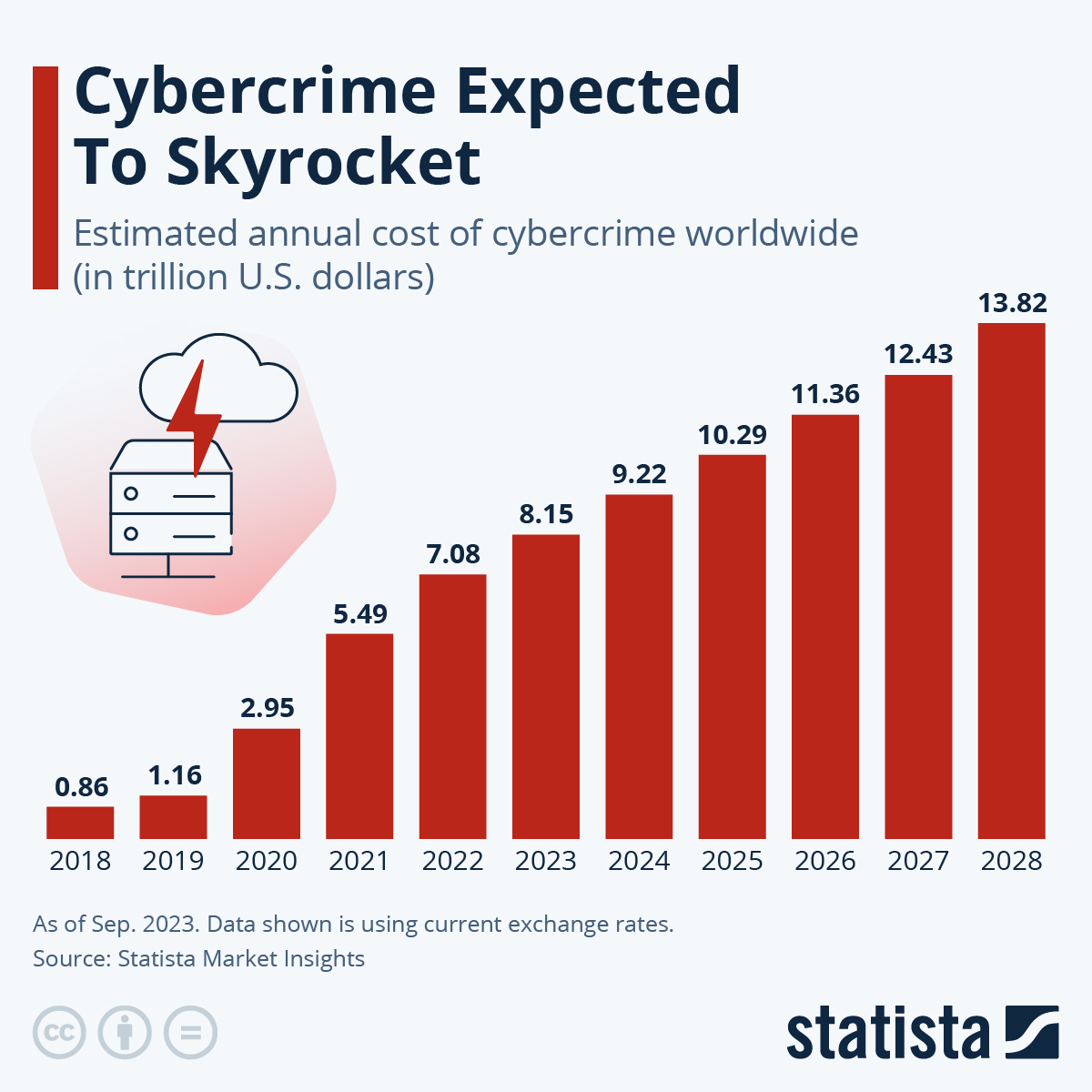 Source: Statista
Why Associations Are Prime Targets
Many associations assume they’re too small or low-profile to attract cybercriminals — but that’s a dangerous myth.
Large corporations have often invested more heavily in cybersecurity for decades, so attackers now look for easier prey: small to midsized organizations that may lack resources or expertise.
Associations, in particular, also hold highly valuable data — member names, contact details, and professional roles — which is highly attractive to cybercriminals because it’s ideal fuel for spear phishing attacks.
“Associations have perfect spearfishing data,” says Scott. “You’ve got titles, employers, and personal details — everything a cybercriminal needs to impersonate someone credible.”
Even small breaches can be costly. Attackers often demand ransoms scaled to an organization’s size — $10,000 or $25,000 — sums small enough to pay quickly but large enough to hurt. Because these incidents rarely make headlines, the risks are often underestimated.
Managed Service Providers (MSPs): Your Best Ally—or Weakest Link
Many associations rely on managed service providers to oversee their IT infrastructure, but not all MSPs are created equal. Scott stresses that associations must carefully vet their partners and treat the relationship as a true partnership, not just a vendor agreement.
Key questions to ask an MSP:
-
Do you undergo third-party cybersecurity audits annually?
If not, they may not follow basic best practices themselves. -
Can you share references from similar-sized associations?
Peer feedback offers insight into reliability and communication style. -
How do you handle growth and customer service?
Large, fast-acquiring MSPs may struggle to maintain quality service, while very small ones may lack depth of expertise.
Scott advises associations to seek MSPs that emphasize collaboration, transparency, and right-sized solutions rather than one-size-fits-all packages.
Quantifying the Risk: The Real Cost of a Breach
Cyber incidents aren’t just technical failures — they’re financial and reputational crises.
Beyond the direct costs of cybercrime (like a data breach) – including downtime, forensic investigations, and remediation – the loss of trust can be devastating. Associations must notify members if personal information was exposed, potentially damaging confidence and renewals.
“Your members trust you to protect their data,” Scott warns. “Lose that trust, and you risk losing members, donors, and your reputation.”
The consequences can even extend to leadership accountability. Boards may question the judgment of executives who failed to prioritize cybersecurity — another reason to elevate it as a strategic, not technical, issue.
The “Big Six” Cybersecurity Essentials for Associations
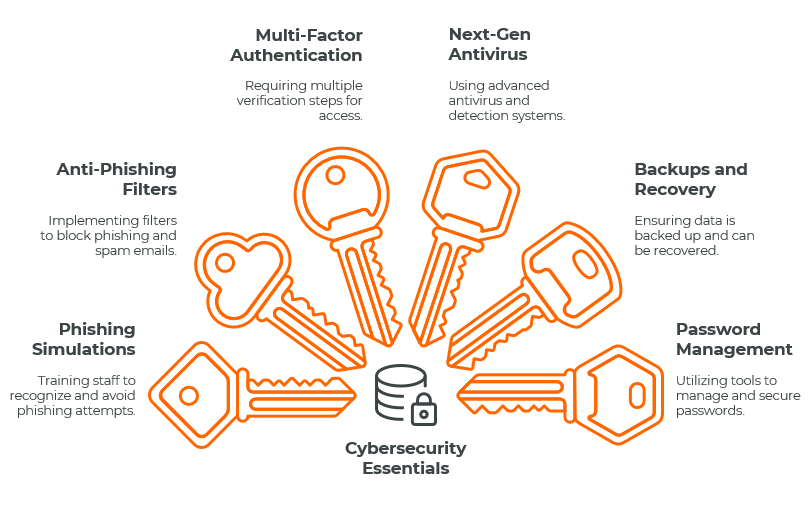
Scott shares what he calls the 501 CISO Big Six — six foundational actions that dramatically reduce risk and strengthen any organization’s cybersecurity posture.
1. Phishing Simulations and Staff Training
Human error remains the leading cause of breaches. Regular phishing tests and cybersecurity training help staff recognize threats and respond safely.
“Your security is only as strong as the least-trained staff member,” Scott notes.
2. Anti-Phishing and Spam Filtering
Upgrade to advanced, third-party filtering tools beyond what’s built into standard email platforms like Microsoft 365.
3. Multi-Factor Authentication (MFA) Everywhere
Don’t stop at email. Extend MFA to your AMS, CRM, VPN, and any system containing member or financial data. Leadership buy-in is key — when executives frame MFA as protecting member trust, adoption follows.
4. Next-Generation Antivirus (NGAV) and Managed Detection & Response (MDR)
Modern threats require smarter tools. NGAV and MDR use AI and behavioral analytics to detect and stop attacks in real time.
5. Reliable Backups and Cloud Recovery
Even cloud data needs backup protection. Cloud sync doesn’t equal security — invest in true, redundant backups to recover quickly after ransomware or data corruption.
6. Password Management Tools
Eliminate password reuse and weak credentials with secure password vaults like LastPass, 1Password, or Bitwarden.
“I have over 700 passwords in my vault and don’t know a single one,” says Scott. “That’s how it should be.”
Cybersecurity Is a Business Risk — Not an IT Issue
Perhaps Scott’s most powerful reminder: cybersecurity belongs in the boardroom, not just the server room.
“Cyber risk is not an IT problem,” he emphasizes. “It’s one of the biggest business risks an organization faces.”
Executive engagement is critical — from modeling good behavior (like using MFA) to supporting training initiatives and budgeting for assessments. Transparency and communication help build a culture of shared responsibility across departments.
Get Help — and Find the Right Fit
Associations don’t need to navigate cybersecurity alone. Scott encourages leaders to seek expert guidance, especially for assessments and vendor selection.
While many cybersecurity firms cater to large enterprises, specialized providers like 501 CISO tailor their services to the nonprofit and association sector — with affordable, right-sized solutions.
“If you don’t know what you don’t know, get help,” says Scott. “Turn on the lights so you can see your risks clearly and act on them.”
Conclusion
In a world where AI-fueled cybercrime grows more sophisticated by the day, protecting your members’ data is both a moral obligation and a business imperative.
As Scott reminds us, cybersecurity isn’t just about technology — it’s about trust, transparency, and leadership. By focusing on education, adopting modern tools, and partnering with trusted experts, associations can safeguard their communities and their missions for the long term.
More Podcast Recaps
Check out more insights from the Member Engagement Show

Turning Association Data into Actionable Insights: Lessons from ASAE’s Christin Berry
Learn how associations can turn data into decisions with insights from ASAE’s Christin Berry on the Member Engagement Show.
Read More
AI and Copyright Law: A Guide for Associations
AI is increasingly becoming part of association workflows. And while that brings amazing capabilities and efficiencies, it also introduces complex...
Read More
SEO Quick Wins for Associations: A Practical Guide
Search Engine Optimization (SEO) might sound daunting, but we’ve got some quick wins you can use if you’re a small...
Read More