
Using Video in Associations: Strengthening Member Engagement and Trust

Is Video Worth it for Associations?
If you spend any time online, you’ve probably seen that video content is trending. People regularly consume TikTok, videos, Instagram Reels, YouTube and short-form clips. Their expectations for how they consume informational and entertaining content has shifted.
But is this primarily a consumer trend—something for influencers and brands with production teams? Or is video worth the investment for associations?
You’ve probably heard me (and others in the association space) say it before: your members’ expectations are shaped by their experience* outside* your association.
So the short answer is YES, video is worth it for associations.
But your next question is probably: how do we embrace video as part of our association’s strategy with limited staff, limited time, and limited budget?
I sat down with Terry Nawrot, CEO and co-founder of VideoRequest to explore how video can help associations and how you can incorporate it in a sustainable way. Listen to the episode below and/or check out the highlights in this post!
Video Reinforces Relationships for Associations
Member expectations have shifted quietly but meaningfully. As Terry explained:
“If you think about how people consume content now, it’s faster, it’s on smaller screens. You’re looking at things on your mobile and a lot of times your sound is off as well.”
In that environment, publishing information isn’t always enough. Members (and prospective members) want to feel connected to the people and ideas behind your content. Video can help communicate tone, credibility, and authenticity quickly. It adds a human layer to digital experiences that might otherwise feel transactional.
That human layer is particularly important in membership organizations. Members don’t just join for content. They join for connection, credibility, and professional identity. Seeing peers speak about their experiences, or hearing directly from leadership, reinforces trust in a way written copy often doesn’t on its own.
So for associations trying to improve first-year member engagement, increase event participation, or build trust with prospective members, that human layer matters.
In Terry’s words: “Video is not just a marketing tool. Video is a relationship tool and an engagement tool that you can utilize in many different ways.”
What Types of Video Should You Capture?
Great, you’re convinced video would help your association deepen connections with members and nonmembers alike. But what kind of videos should you be making?
One of the more limiting ways to think about video is as something you “add on” to a marketing campaign. A better framing is to think about is as part of your engagement infrastructure.
Ask yourself:
- Where in the member journey would a human presence reduce friction?
- Where could hearing a person explain something improve clarity and understanding?
- Where would hearing from peers or thought leaders strengthen credibility?
Some examples that Terry and I discussed…
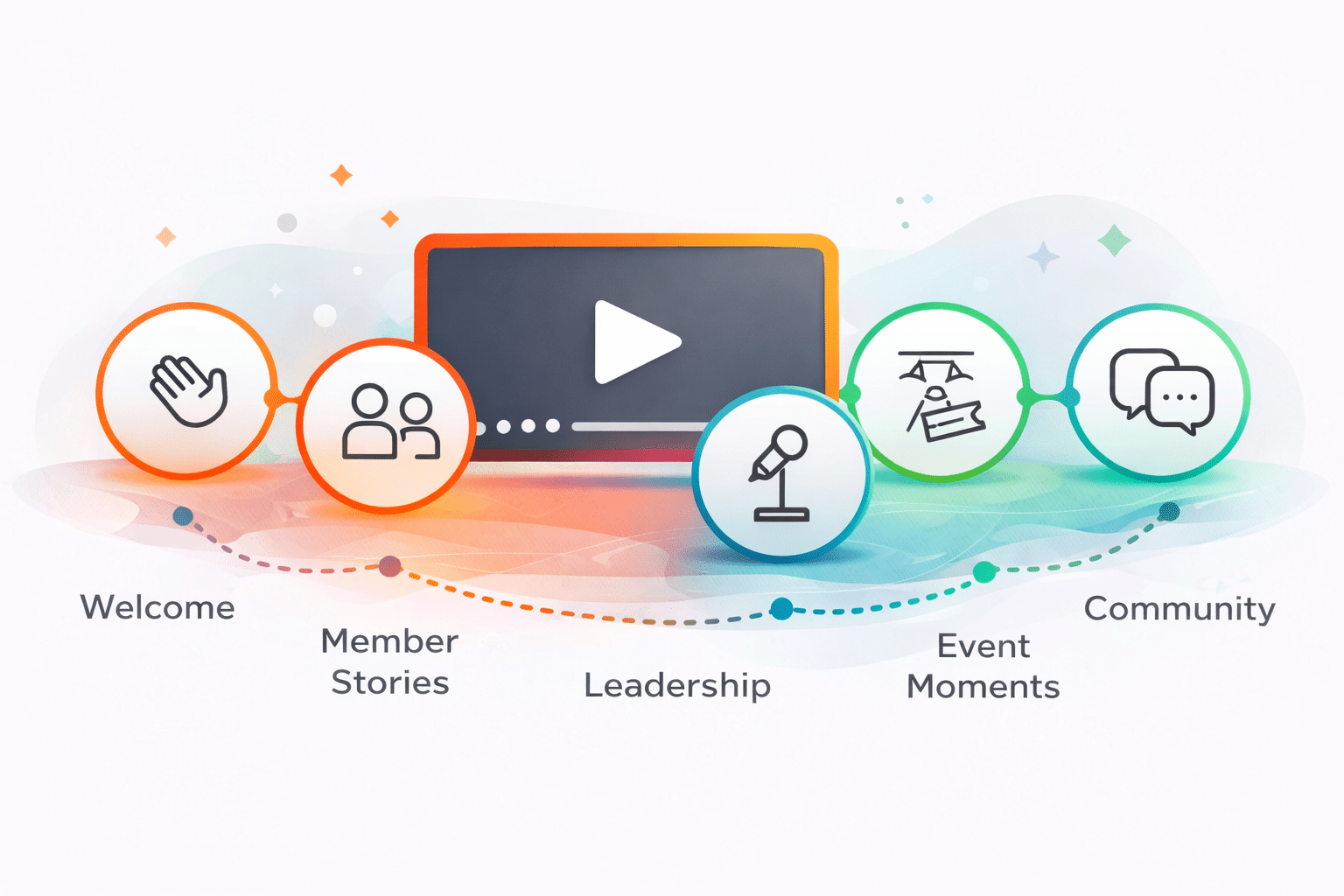
Welcoming New Members
A short welcome video can build familiarity immediately. Nawrot suggested:
“Maybe you’re sending out a welcome video to a brand new member. That’s a great way to put your face in front of them and really thank them for being part of the organization.”
That early relational touchpoint can influence long-term engagement far more than we sometimes realize.
Member Recruitment and Storytelling
Prospective members trust other members more than they trust promotional copy. Hearing directly from peers goes a long way. Collecting and sharing short videos from existing members sharing their stories illustrates the impact of your association. Member-driven video testimonials embedded on landing pages, included in email campaigns, or featured in community spaces can reinforce credibility in an authentic way.
Leadership Transparency
Video also supports visibility and trust at the leadership level. When executive teams or board members share updates directly, members feel closer to the decision-making process. It adds voice and tone to strategic communication.
Behind the Scenes at Events
Events are one of the most natural places to incorporate video. Short clips from attendees, speakers, sponsors, or even staff can capture energy and credibility in a way post-event recap emails often can’t.
A brief “Why I’m Here” interview. A 30-second takeaway from a keynote speaker. A quick behind-the-scenes moment that shows the community coming together. These clips not only extend the life of your event content, they also serve as powerful recruitment and retention tools long after the conference ends. Prospective attendees see what they’re missing. Current members are reminded of the value of showing up.
These are just some of the types of videos you could capture and use for your association, but video can be applied anywhere you think that seeing and hearing from a human being would help improve engagement. Talk with your team to brainstorm the types of videos you might be able to capture and test them out!

How to Create a Sustainable Video Strategy
As I shared with Terry during the episode, time and effort were my main concerns when I thought about taking on video content. And that’s the most common hesitation associations cite too.
Video feels like something extra you have to do all by yourself.
But Terry said that’s one of the biggest misconceptions about video:
“People think it has to be just one person that’s doing all of the content creation. And that feels like too much work. But it really it doesn’t have to be all on you… There are so many more people that can be involved in the process of creating videos when you remove the technical barriers.”
Associations already have subject matter experts, volunteer leaders, event speakers, and written content that can be adapted. So it comes down to repurposing where you can, distributing the effort, and simplifying the process.
What does that look like?
Video Tools That Help Associations
Well, if you have the right tools, capturing, editing, and sharing videos becomes a lot easier. Higher Logic partnered with VideoRequest to offer our newest add-on product, Higher Logic Thrive Video, which helps associations scale their video efforts without needing a whole production team:
- Invite others to submit videos by creating a video request and sharing the link. This makes it easy for people to record a video at their convenience without having to schedule a Zoom call. The platform offers teleprompter functionality and script assistance to help guide your invited participants, keeping them on topic and ensuring you get the best story. And this submission process makes it easy for you to collect videos without having to chase down files.
- Review, edit, and approve clips from an organized library. Maintain video quality and consistency even when content is coming in from multiple contributors. Terry pointed out on the podcast that the editing capabilities in a tool like Higher Logic Thrive Video have gotten pretty impressive. “AI is playing a big role in making it easier to create these authentic polished videos. You have tools that can improve the audio, remove the background, generate transcripts and translations. I think that’s another barrier people worry about: being able get quality videos from contributors. But with the right tools it almost doesn’t matter. I can remove the background noise, I can remove the physical background. Even eye correction is a tool that you can utilize, where you can correct someone’s gaze if it’s going all over the place during the video, reducing distraction.”
- Get your videos out there! Once approved, videos can be published directly into your Higher Logic Thrive Community feed or reused in marketing emails, helping you spark discussion and extend the reach of every piece of content without extra lift.
This is all designed to help you save time, reinforce key messages, and build a repeatable process that integrates natively with your engagement ecosystem, rather than adding yet another point of friction.
Shifting Video Quality Expectations
Whether you use Higher Logic Thrive Video, or another video capture/editing tool, it’s still more doable than ever to incorporate video into your engagement strategy. That’s because people’s expectations around video quality and productions standards have evolved.
Members don’t expect perfection. They want authenticity and transparency. They don’t need your videos to look perfect, as long as they feel human and real and offer them something they can either learn from or connect with.
As Erin Fuller of MCI pointed out on a previous episode of The Member Engagement Show, we live in a time where people often consume off-the-cuff “get ready with me” style content. “In associations, there’s a lot of pressure for us to present everything as it looks perfect,” said Erin. “But I think organizations that kind of pull that curtain and give a behind the scenes tour of some of the elements that go into association management, for example events, can really attract interest.”
It’s awesome that video tools (with the help of AI) can reduce technical barriers, making editing, transcription, translation, and background cleanup more manageable than ever for small teams. But you don’t need to aim for hyper-produced, extra polished video content. It’s okay (and, in fact better) to be human and real.
Distribution Is Broader Than Social Media
So now you HAVE videos. Where should you share them?
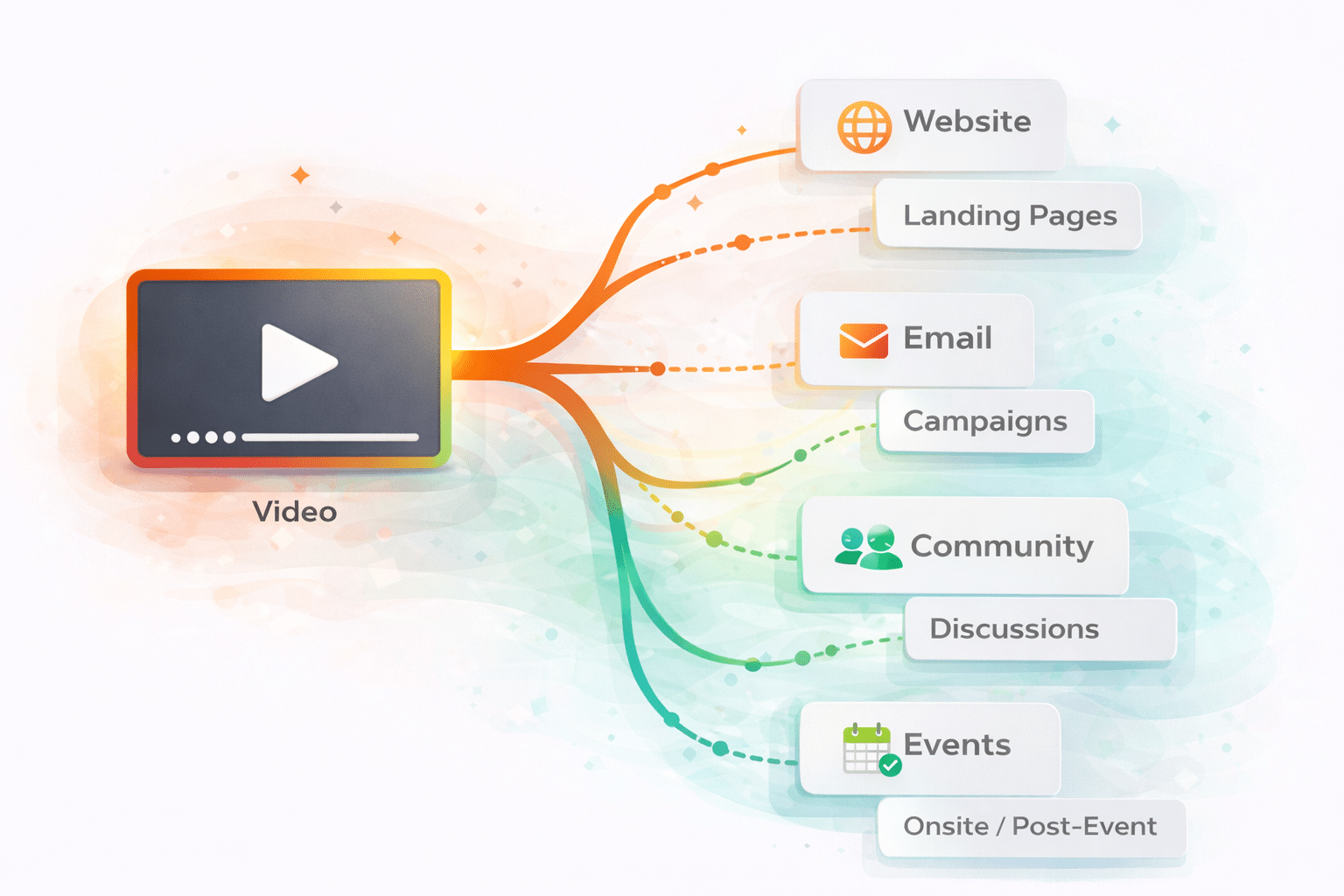
Social media is one channel where video can help drive engagement, but it’s not the only one. Many associations see strong impact from embedding video on website landing pages, including it in email campaigns, featuring it inside community platforms, or incorporating it into sponsorship packages.
The key is aligning placement with member behavior.
Where are your members already spending time?
Where would video reduce friction or build trust?
That’s where it belongs.
Measure What Reflects Real Engagement
And then how do you tell if your video strategy is working?
Nawrot emphasized that associations should look beyond views alone. They’re worth checking, but they don’t tell the whole story. You should also pay attention to metrics like including watch time (how long someone stays on your video) and where people fall off. Completion rates and follow-through actions can also give you meaningful insights into whether your videos are driving your desired actions.
On top of that, if video is integrated into your online community, whether within community discussions, marketing automation workflows, or landing pages, that can be part of your broader behavioral data tracking too.
You can begin to see patterns:
- Which topics sustain attention
- Whether first-year members engage differently
- Which calls to action drive response
This is where video strengthens personalization and engagement strategy, rather than operating as a standalone tactic.
How to Get Started with Video
If your association is early in its video strategy, resist the urge to overproduce. Your initial goal isn’t to churn out tons of videos right away. It’s to build a repeatable process your team can sustain.
Here’s a simple kickoff roadmap that works well for associations with limited time and staff.
Step 1: Pick one outcome (not “more video”)
Start by choosing a single goal that ties to member value.
- Improve first-year member engagement
- Increase event registrations
- Support member recruitment with peer proof
- Drive more community participation around a priority topic
When the outcome is clear, it’s much easier to decide what to record and what to skip.
Step 2: Choose one use case and one channel
Don’t start with five formats across five platforms. Start with one high-impact use case and publish videos where your members already engage.
Examples:
- A welcome video embedded in a new-member email sequence
- A member testimonial on a join/renew page
- A short event takeaway posted in your community to spark discussion
This keeps the effort focused and makes results easier to measure.
Step 3: Define the “minimum viable video” format
Short, focused content often performs better than long recordings and it’s faster to produce.
A good starting set:
- A 30- or 60-second insight clip
- A single question answered by a member
- A brief event highlight
Give contributors a clear prompt and a time limit. You’re not trying to capture everything. You’re trying to capture something useful.
Step 4: Make it easy for others to participate
This is where many associations get stuck: video becomes “someone’s job” instead of a shared input.
Create a simple request workflow (link-based submissions help), provide a short script or bullet outline, and ask for a small number of videos at a time (e.g., 3–5). The goal is consistency, not volume.
Step 5: Set a lightweight cadence
A content calendar doesn’t need to be complicated. Start with one publishing rhythm your team can realistically maintain. For example:
- 2 videos per month, or
- 1 video per event milestone (pre-event, onsite, post-event)
Once the cadence is stable, you can expand.
Step 6: Review results and iterate
There is space for longer-form educational content, but attention data consistently shows that clarity and brevity matter.
After your first few videos, look for practical signals:
- Where do viewers drop off?
- Which topics hold attention longer?
- Did the video drive the action you wanted (click, registration, reply, discussion)?
Use what you learn to tighten the next round. That’s how video becomes sustainable and strategically useful instead of becoming another content project that fades out after a month.
The Larger Opportunity for Video
As associations digitize more of the member experience, from onboarding to community engagement to continuing education, a central tension remains:
How do you scale efficiently without losing human connection?
Technology enables automation and insight. But relationships still drive retention. Video can be really helpful in bridging that gap. It puts faces behind the organization. It reinforces peer credibility. It strengthens the sense of belonging that membership depends on.
And when integrated intentionally within your engagement ecosystem, it becomes measurable and sustainable, not sporadic.
As video becomes easier to create it becomes more accessible to organizations with limited time. But it’s important to set a clear purpose as you embrace video. Consider:
Where would video strengthen trust?
Where could video support the member journey?
Where would make expertise more accessible?
If you’re exploring how to incorporate video more seamlessly into your community and engagement strategy, Higher Logic Thrive Video, powered by VideoRequest, makes it easier to collect, manage, and measure authentic member-driven content within your existing ecosystem.