
No Community Left Behind:
How Missouri Rural Health Association Is Transforming Access to Care in Rural Missouri with Higher Logic Thrive

About the Missouri Rural Health Association
The Missouri Rural Health Association (MRHA) is a nonprofit, member-driven organization dedicated to improving healthcare access and outcomes for rural Missourians through advocacy, education, and strategic partnerships.
For more than three decades, MRHA has served as a unified voice for rural health, ensuring that the unique challenges faced by small towns and remote communities are not overlooked in state and federal decision-making.
Their work spans every layer of the rural healthcare ecosystem:
- Advocacy & Policy: Influencing legislation on Medicaid expansion, practitioner authority, and rural hospital sustainability
- Education & Resources: Hosting statewide conferences, delivering educational programming, and supporting strategic planning for rural providers
- Addressing Social Determinants of Health: Conducting needs assessments and research to uncover barriers beyond the clinic walls
- Partnership & Collaboration: Connecting providers, policymakers, researchers, and community leaders to share data and best practices
- Targeted Programs: Supporting initiatives like HealthTran, which improves transportation access to healthcare services for rural residents
At its core, MRHA exists for one reason: To ensure that where someone lives does not determine whether they receive care.
For more than 1.5 million rural Missourians (nearly one-third of the state’s population), healthcare access isn’t theoretical.
It’s personal.
It’s the mother who drives 90 minutes for prenatal care.
The farmer delaying treatment because the nearest clinic closed.
The senior without broadband who cannot access telehealth.
The volunteer EMT covering three counties.
Across rural Missouri, healthcare access isn’t simply uneven, it’s structurally strained.
- More than 78% of Missouri’s Health Professional Shortage Areas (HPSAs) are rural
- Entire counties lack nearby hospitals
- Transportation barriers stretch emergency response times
- Broadband gaps limit telehealth access
- Workforce shortages intensify burnout
Behind every statistic is a neighbor. A family. A life impacted by distance.
MRHA knew the crisis wasn’t isolated to one region or one discipline.
So they asked a simple but urgent question: What are rural health leaders actually experiencing?
The Real Challenge: Fragmentation
Before Higher Logic Thrive, MRHA faced a familiar association challenge, magnified by geography.
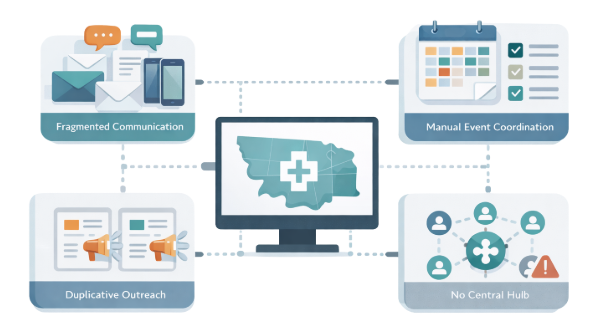
Communication was fragmented across tools.
Event coordination was manual.
Outreach was duplicative.
There was no central hub for asynchronous collaboration.
Engagement was happening, but it wasn’t measurable.
Meanwhile, stakeholders were naming clear statewide priorities:
- Access to care (52.1%)
- Workforce development (45.8%)
- Policy and advocacy (37.5%)
These weren’t newsletter topics. They were systemic issues requiring cross-sector alignment — because when one rural hospital closes, an entire community feels it.
MRHA didn’t need another website. They needed a digital backbone capable of sustaining collaboration, advocacy, and shared learning across the entire state — so that no rural provider, policymaker, or advocate would feel like they were solving impossible problems in isolation.
Implementation: Building The Causeway with Higher Logic Thrive
MRHA selected Higher Logic Thrive to build what would become The Causeway — not simply an online community, but a structured, statewide virtual infrastructure for rural health coordination.
The name was intentional: A causeway connects land separated by water. It makes what feels distant reachable.
The goal was ambitious:
- Move from connection to coordination.
- From conversation to application.
- From siloed effort to collective capacity.
Using Higher Logic Thrive, MRHA consolidated communication, engagement, events, and resource distribution into a single, scalable system.
But more importantly, they designed it intentionally — around the realities of rural life.

Designing Infrastructure, Not Just Engagement
The Causeway wasn’t built as an open forum, it was architected.
Four primary connection points anchored the system:
- MRHA Core (staff, board, volunteers)
- Rural Voices (citizens, providers, stakeholders)
- Resources (academics, vendors, policy experts)
- External Hubs (including national partners)
Within that structure, Higher Logic Thrive enabled MRHA to build:
- Role-based communities
- Region-specific hubs
- Issue-focused subcommunities
- Centralized document and resource libraries
- Integrated event registration and payment tools
- Real-time feedback loops with state and federal partners
- Asynchronous discussion spaces that reduce meeting fatigue
This wasn’t about creating conversation for conversation’s sake. It was about ensuring that when a rural clinic finds a solution, that solution doesn’t stay local — it spreads.
The result wasn’t a message board, it was a living coordination engine serving communities that cannot afford inefficiency.
Results: Streamlined processes & member satisfaction.
A Network of Experienced Leaders That Are No Longer Isolated
Today, The Causeway spans more than 25 professional roles across every region of Missouri.
This isn’t a passive audience. It’s executives, policy advocates, frontline providers, educators, system administrators.
- 70% of members bring at least 8 years of healthcare experience
- 41.7% bring more than 15 years
Many serve communities where they are the only specialist, the only administrator, or the only advocate in miles.
Higher Logic Thrive supports participation across the full engagement spectrum:
- 27.1% primarily observe
- 25% contribute occasionally
- 25% contribute regularly
- 10.4% lead or coordinate
That layered participation matters. Because in rural health, sometimes observing a peer’s solution today becomes implementing it tomorrow — saving months of trial and error a community cannot afford.
Measuring Engagement as Infrastructure
Many associations measure engagement by logins. The Causeway measures it by value creation. Using a structured framework, MRHA evaluates engagement across five stages: immediate, potential, applied, realized, and reframed value. The early signals are meaningful:
63%
Report immediate value
62%
Report building knowledge for future application
47.9%
Gained helpful ideas or encouragement
45.9%
Formed new professional relationships
In rural environments where professional isolation and burnout are persistent risks, encouragement isn’t soft.
It’s protective.
When providers feel supported, communities benefit.
From Dialogue to Impact
The real shift began when engagement translated into action.
- 58% report applying insights in practice
- 58% report emerging organizational improvements
- 12.5% already report measurable outcomes
Only 6.3% frequently apply what they learn — but 36.9% plan to.
That gap isn’t weakness, it’s momentum. And it’s visible because Higher Logic Thrive makes progression measurable.
Every applied insight represents a patient served more efficiently, a program launched faster, or a barrier reduced.

Enabling Community-Led Innovation
With The Causeway serving as infrastructure, collaboration accelerated.
Members coordinated:
- Mobile health units
- Telehealth hotspot initiatives
- Sliding-scale clinics
- Volunteer driver networks
- Project ECHO programs
- Medicaid enrollment support
- Mobile crisis unit guides
Behind each initiative is a rural citizen gaining access that didn’t exist before.
The platform doesn’t create the innovation, it ensures innovation doesn’t stay isolated.
In rural healthcare, distance is inevitable. Isolation doesn’t have to be.
Infrastructure Changes Outcomes
MRHA’s adoption of Higher Logic Thrive represents more than a technology implementation.
It represents a structural shift:
From fragmented outreach to coordinated infrastructure.
From siloed expertise to measurable collaboration.
From isolated effort to collective capacity.
In rural health, infrastructure determines what is possible.
And when infrastructure improves, access improves.
When access improves, outcomes improve.
When outcomes improve, communities remain viable.
Higher Logic Thrive helped MRHA build the connective tissue that rural Missouri depends on.
Because in public health — especially in rural America — connection isn’t convenience.
It’s care.
Higher Logic would be happy to help your organization build a thriving, connected membership journey — just like MRHA. Contact us for a walkthrough!