
The Next Evolution of Association Value is Member Intelligence

Why are associations struggling to prove their value proposition?
Most associations already offer what members say they want: trusted expertise, professional development, advocacy, standards, community, volunteer opportunities, events, research, and peer connection. But when members have to search through crowded inboxes, disconnected systems, and long lists of benefits to find what applies to them, even strong value can remain invisible.
Succeeding today means understanding what each member is trying to accomplish and making the right resource, connection, or next step easier to find. This is increasingly important because members and potential members are now constantly surrounded by information. They can search online, ask an AI tool, follow industry influencers, join informal peer groups, or look to vendors for education. In this environment, value cannot simply exist. It has to reach members in ways that feel timely, relevant, and useful.
Higher Logic’s recent association research reinforces that members want value that is relevant, easy to access, connected to their goals, and more responsive to their engagement. In the 2025 Association Member Experience Report:
- 84% of members said a personalized member experience is important enough that it impacts their retention intent.
- 51% of members said they receive too many emails, even as members increasingly expect communications to be relevant to their needs
- 80% of members said it is very or extremely important for their association to help them track completed education and see the next step in their professional journey.
Together, those findings point to the next evolution of member value: not simply offering more or communicating more, but listening and understanding more so associations can deliver support that feels relevant to each member.
That’s where member intelligence comes in.
Member intelligence is an association’s ability to understand what members need, where they are in their journey, what challenges they are trying to solve, and which forms of value will help them make progress. It comes from the signals members already provide: community discussions, event participation, learning activity, survey responses, renewal behavior, volunteer involvement, content engagement, member service conversations, and the language members use to describe their own work.
Artificial intelligence can help associations make those signals more usable and reduce the manual effort of delivering on those signals. AI can summarize, categorize, detect patterns, surface themes, recommend next steps, and make knowledge easier to find. Applied responsibly, it can help associations move from passive benefits to proactive value delivery.
From passive benefits to proactive value delivery
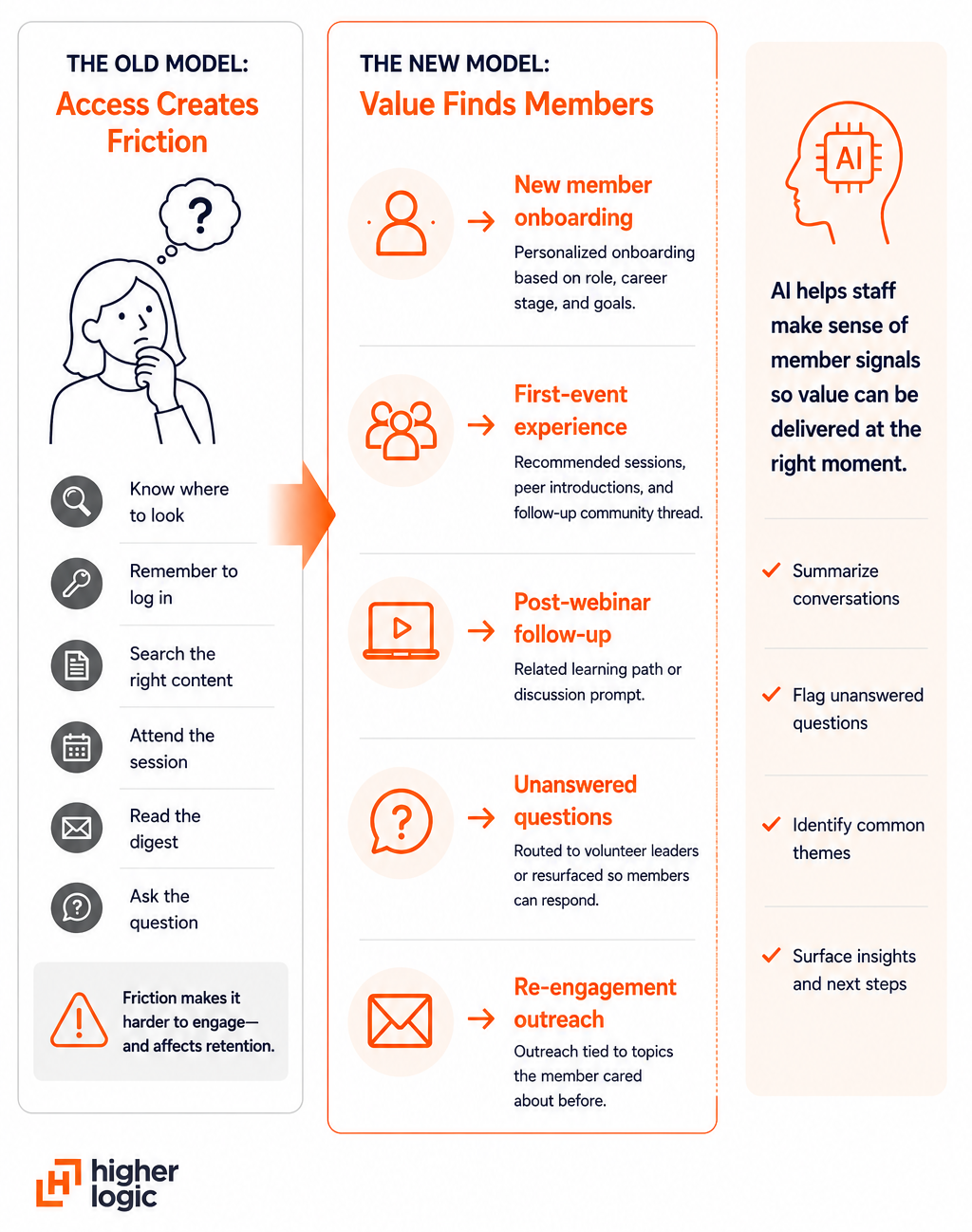
For years, many associations have organized value around access: access to a resource library, conference, newsletter, online community, or certification program. Those benefits are still important. But access alone places a heavy burden on members.
Members have to know where to look and recognize what applies to them. They have to remember to log in, search the library, attend the session, read the digest, or ask the question.
That friction has real retention implications. The latest Association Member Experience Report found that members who said it was “very easy” to get involved with and get value from their association reported far higher engagement, value perception, and five-year renewal intent than those who found engaging difficult. In other words, making value easier to find is not just a better experience; it is a retention strategy.
A more proactive membership model starts with a different question than “What do we offer?” It asks, “What does this member need next, and how can we help them get there?”
That shift can show up in practical ways:
- A new member might receive onboarding based on their role, career stage, and goals.
- A first-time conference attendee might get recommended sessions, peer introductions, and a follow-up community thread.
- A member who attends a webinar might receive a related learning path or discussion prompt.
- A question that goes unanswered in the community might be sent to volunteer leaders or resurfaced automatically so members can respond.
- A member who has stopped engaging might receive outreach tied to the topics they cared about before.
AI can support these moments by helping staff see what is happening across the member experience. It can , flag unanswered questions, identify common themes in feedback, and help staff understand what members are trying to solve.
The goal is not to automate the relationship. The goal is to make sure valuable member signals do not disappear into disconnected systems, crowded inboxes, or staff to-do lists that are already too long.
Where to start: Pick one moment where members commonly have to find value on their own, such as onboarding, first-event participation, renewal, or post-webinar follow-up. Identify one signal you already have from that moment, then use it to trigger one more relevant next step.
Turning information overload into useful understanding
Associations also have another advantage: they sit on a tremendous amount of trusted knowledge no one else has, including conference recordings, journals, research reports, policy updates, community discussions, benchmarking data, committee work, volunteer expertise, and member-created resources.
The problem is that members often can’t find what they need when they need it.
In an AI-driven world, one of the strongest future value propositions for associations may be helping members make sense of information overload. Members do not need another blasted email, generic content feed, or giant list of things to sort through. They need trusted curation and context. They need to know which development matters, which peer conversation is relevant, which resource applies to their role, and what action to take next.
AI can help associations It can turn the search in your online community into a convenient answer-engine, helping people benefit from solutions their peers already figured out (or making it easy for them to ask their community if an answer doesn’t exist yet). It can help build role-based briefings from existing content or connect a member’s interest in a topic to a past conference session, a current discussion thread, and an upcoming learning opportunity.
These are more than content improvements: they are relevance improvements. They make the association’s expertise easier to find, use, and harder to replace. When an association can help members move from “I am overwhelmed” to “I know what matters and what to do next,” it evolves from a source of information to a professional lifeline.
Where to start: Choose one high-value content source, such as a webinar transcript, conference session, community discussion, or research report. Use AI to create two or three practical formats from it, such as a summary, checklist, FAQ, role-based briefing, or discussion prompt. (Better yet, create a repeatable prompt or workflow so staff can use the same process again).
More customized member journeys
Associations have long known that one-size-fits-all engagement does not reflect how members actually experience value. The challenge has been capacity. Personalization takes time, clean data, coordinated systems, and enough staff attention to turn member signals into meaningful next steps.
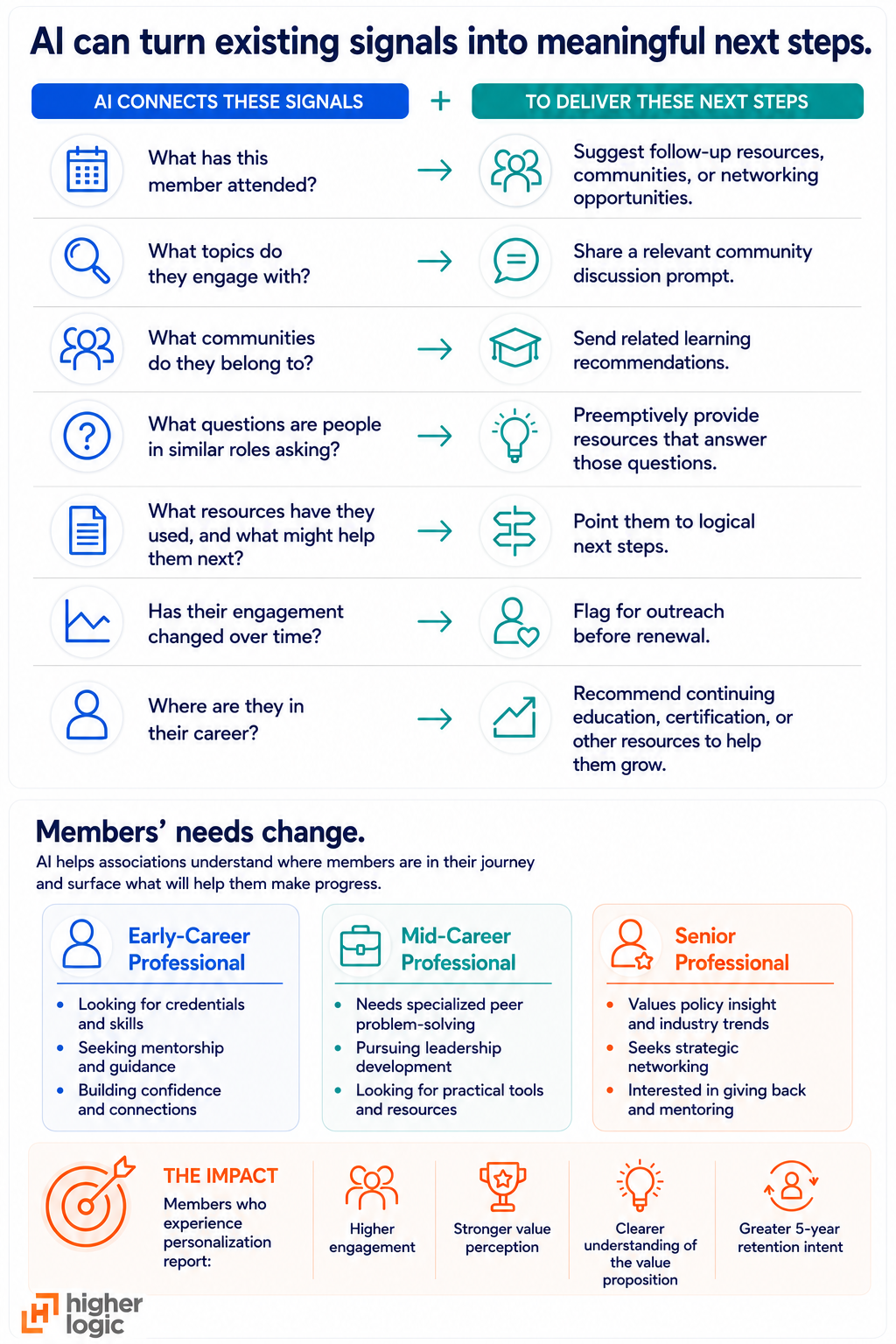
But the impact is clear. Members who feel their association provides a personalized experience report higher engagement, stronger value perception, clearer understanding of the association’s value proposition, and greater five-year retention intent.
AI can help make that kind of personalization more realistic by connecting behavioral and engagement signals that already exist across the member experience. AI-powered automation can also help associations act on those signals consistently.
A member’s needs change based on career stage, role, organization type, interests, and current challenge. An early-career professional may be looking for credentials, mentorship, and confidence. A mid-career member may need specialized peer problem-solving or leadership development. A senior member may value policy insight, strategic networking, or opportunities to give back.
Trade associations face a similar challenge across roles inside member companies. The executive decision-maker, technical expert, operations leader, and emerging professional may all value the association differently. The core promise of membership can stay consistent, but the path to that value should not be one-size-fits-all.
AI can help associations make existing signals easier to act on:
- What has this member attended?
- What topics do they engage with?
- What communities do they belong to?
- What questions are people in similar roles asking?
- What resources have they used, and what might help them next?
From there, certain next steps can be automated or semi-automated, with staff review where needed. A new member could be added to an onboarding path based on role or interests. A webinar attendee could receive a related learning recommendation or community discussion prompt. A member who visits a certification page several times could receive information about the next deadline. A first-time event attendee could get suggested sessions or networking opportunities. A member whose engagement has dropped could be flagged for outreach before renewal.
That combination of intelligence and automation can support better onboarding, smarter renewal communications, more relevant event recommendations, personalized learning pathways, segmented volunteer opportunities, and timely outreach. When those signals shape the next message, recommendation, invitation, or outreach moment, engagement no longer depends only on members searching through every benefit themselves. The association is bringing the next relevant step to them.
Where to start: Choose one member segment, such as new members, early-career professionals, first-time event attendees, volunteer leaders, or members nearing renewal. Map what they likely need next, then identify one communication, resource, event, or community connection you could recommend more intentionally. Then decide what can be automated, what should be reviewed by staff, and what still needs a personal touch
Getting to the work that usually sits beyond reach
Most association teams know what they would do with more time. They would follow up with more members, personalize onboarding, analyze community conversations, test new and different event formats, turn event content into evergreen resources, identify disengaged members sooner and re-engage them, or create clearer member journeys.
But staff capacity creates constant tradeoffs.
AI does not remove the need to prioritize. It does, however, reduce the cost of getting started. It can help draft, summarize, analyze, repackage, classify, compare, and identify patterns. It can take repetitive preparation work off staff plates so they can spend more time on strategy, creativity, innovation, and relationship-building.
That matters because many of the projects that improve member value are not ignored because associations don’t care. They are delayed because teams are already stretched thin.
AI can help associations get to the work that usually sits just beyond reach.
For example, an association might use AI to:
- Summarize a month of community discussions, identify unanswered questions, and create a staff-reviewed digest.
- Analyze open-ended survey responses and identify themes worth exploring in focus groups.
- Convert a conference session into follow-up resources for different member segments.
- Compare member feedback against current offerings and reveal gaps.
These uses give staff more room to strategize and apply human judgment.
Technology debt can make this harder. Disconnected systems, manual workarounds, and scattered data prevent associations from seeing the full member picture. That is why AI should be considered alongside data readiness, governance, and staff capacity.
Where to start: Look at the work your team repeats every week: summarizing feedback, drafting follow-up emails, tagging content, preparing event materials, reporting on engagement, or answering the same member questions. Repetitive, time-consuming, rules-based work is often where AI can create capacity fastest.
Listening beyond the loudest signals
Member intelligence also requires discernment.
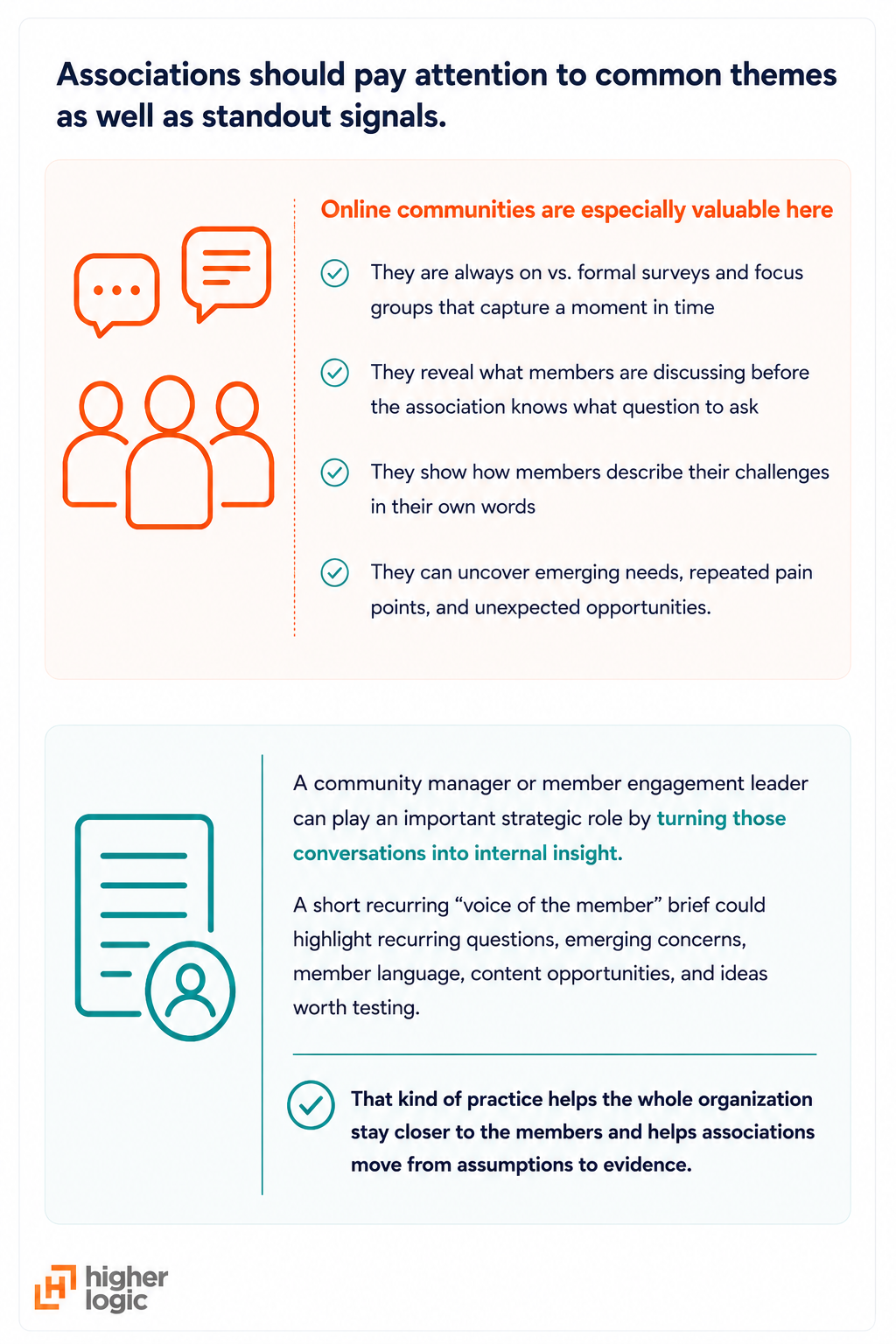
Associations should pay attention to common themes, but innovation does not always come from the majority opinion. Sometimes the most useful signal is a single comment that makes staff pause and ask, “What does that mean?” or “What would happen if we explored this further?”
Online communities are especially valuable here because they are always on. Formal surveys and focus groups capture a moment in time. Communities can reveal what members are discussing before the association knows what question to ask. They can show how members describe their challenges in their own words. They can uncover emerging needs, repeated pain points, and unexpected opportunities.
They are also a channel members already value. The 2025 Association Member Experience Report found that 79% of members describe their association’s online community as very or extremely valuable for networking and learning, while the 2025 Association Community Benchmark Report found community engagement remained strong and stable even as AI-powered tools changed how people look for information.
A community manager or member engagement leader can play an important strategic role by turning those conversations into internal insight. A short recurring “voice of the member” brief could highlight recurring questions, emerging concerns, member language, content opportunities, and ideas worth testing. That kind of practice helps the whole organization stay closer to members.
It also helps associations move from assumptions to evidence.
Where to start: Create a short monthly voice-of-the-member brief. Include recurring themes, exact member language, unanswered questions, emerging needs, and one or two ideas worth testing. Keep it short enough that staff and volunteer leaders can read it in a minute or two.
Human connection remains the advantage
AI can help associations summarize knowledge, personalize journeys, and act on member signals faster. But the association’s advantage is still deeply human.
Associations convene people who share a profession, industry, mission, or challenge. They create trusted spaces where members can ask peers what is actually working. They provide context that a general AI tool may not have. They understand nuance, ethics, standards, advocacy, and the lived realities of a field.
AI should support that value, not flatten it.
Members appear open to that kind of AI-supported experience when it is handled thoughtfully: 60% of members are comfortable with their association using AI to improve their experience, while another 34% are somewhat comfortable but want transparency and reassurance. That suggests the path forward is not avoiding AI, but applying it in ways that are clear, useful, and human-centered.
That requires responsible use. Associations need clear guardrails for privacy, data quality, transparency, and human review. They need to understand which data can be used, which should not be used, and where staff judgment is essential. They also need to be transparent when AI helps create summaries, recommendations, or member-facing resources.
The goal is to remove friction so staff and volunteers can spend more time delivering the human value members joined.
Where to start: Do not start with the AI tool. Start with the member problem, the data you already have, the staff workflow that needs relief, and the decision a human still needs to make. From there, see if systems you already use have AI tools built in to help you; it’s easier to adopt something prebuilt in a system you’re already logging into than to change your behavior entirely.
A practical place to start
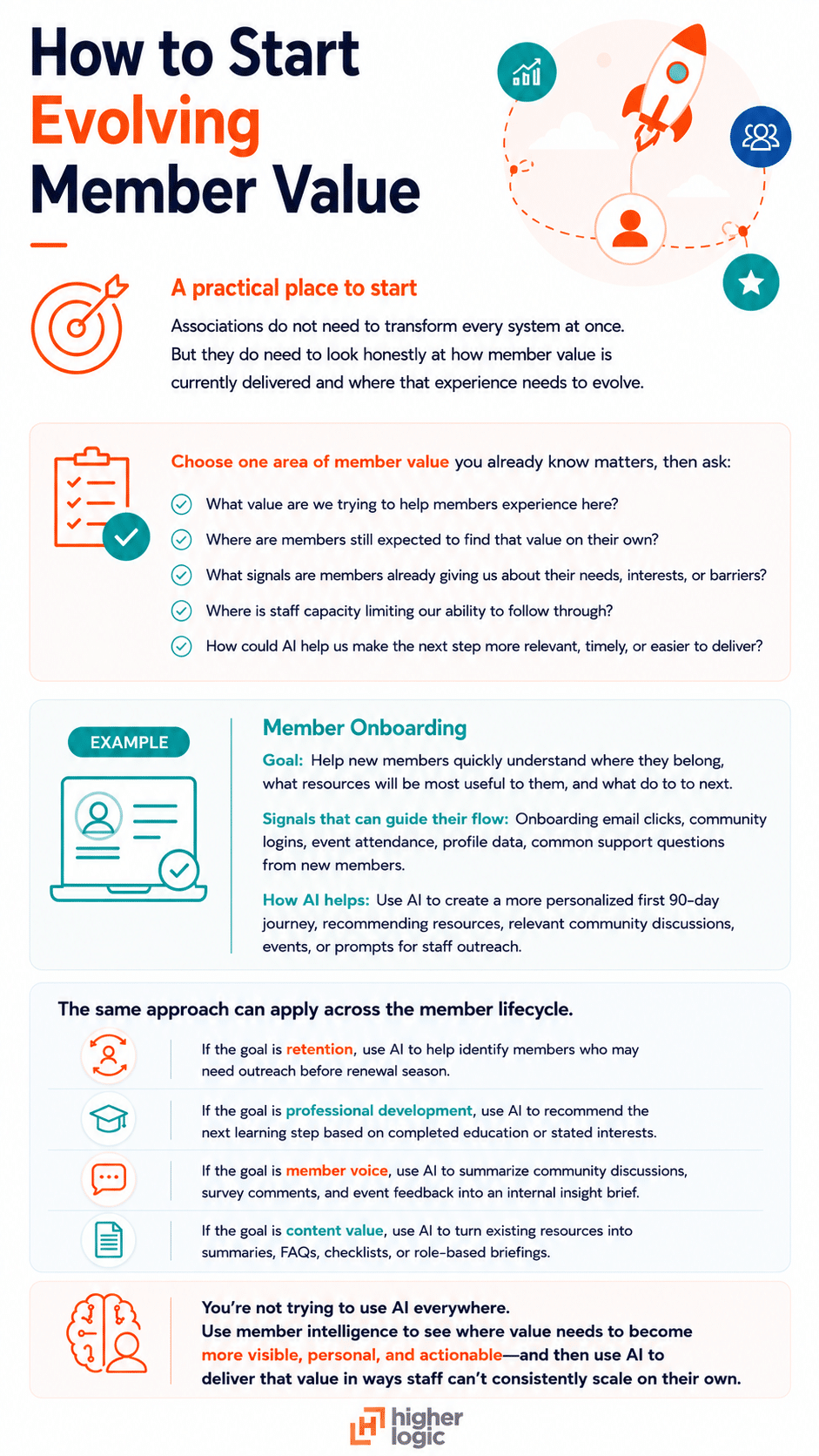
Associations do not need to transform every system at once. But they do need to look honestly at how member value is currently delivered and where that experience needs to evolve.
A practical starting point is to choose one area of member value you already know matters, such as onboarding, renewal, professional development, community engagement, or volunteer involvement. Then ask:
- What value are we trying to help members experience here?
- Where are members still expected to find that value on their own?
- What signals are members already giving us about their needs, interests, or barriers?
- Where is staff capacity limiting our ability to follow through?
- How could AI help us make the next step more relevant, timely, or easier to deliver?
For example, if the focus is new member onboarding, the goal is not simply to send a welcome email. The goal is to help new members quickly understand where they belong, what resources matter most, and what action to take next. An association could look at signals like onboarding email clicks, community logins, event attendance, profile data, and common support questions, then use AI to help create a more personalized first-90-days journey: recommended resources, relevant community discussions, suggested events, or prompts for staff outreach.
The same approach can apply across the member lifecycle.
- If the goal is retention, use AI to help identify members who may need outreach before renewal season.
- If the goal is professional development, use AI to recommend the next learning step based on completed education or stated interests.
- If the goal is member voice, use AI to summarize community discussions, survey comments, and event feedback into an internal insight brief.
- If the goal is content value, use AI to turn existing resources into summaries, FAQs, checklists, or role-based briefings.
You’re not trying to use AI everywhere. Instead, use member intelligence to see where value needs to become more visible, personal, and actionable and then use AI to help deliver that value in ways staff could not consistently scale on their own.
The future of member value
The future of association value will not be defined by who publishes the most information or offers the longest list of benefits. It will be defined by who helps members make sense of what matters, connect with the right people, and take the next right step.
AI will not make associations valuable on its own. But it can help associations see member needs sooner, act on them faster, and deliver value more personally and consistently.
That is the opportunity in front of associations now: to move from value promised to value experienced.
And in an environment where members are overwhelmed with information and options, the associations that stand out will be the ones that make members feel understood, supported, and guided — not just at renewal time, but throughout the entire member journey.
Make member value easier to deliver
Your association already creates meaningful value. Higher Logic helps make that value easier for members to find, experience, and act on. Our community, marketing, automation, and AI-supported solutions are designed specifically for associations, helping teams understand member needs, personalize engagement, and show the impact of their work.