
Association Email Benchmarks: 7 Insights That Should Inform Your 2026 Strategy

Email remains one of the most important engagement channels associations use to connect with members—but the rules of effective email are always evolving. Inbox competition, privacy protections, automatic email categorization, and changing audience behavior are all influencing how members interact with messages and whether your emails are even seen.
Higher Logic’s 2025–2026 Association Email Benchmark Report analyzes performance data from approximately 1,500 associations and nonprofits and more than 2 billion emails sent. The findings provide a clear look at how association email engagement is shifting—and what marketing and membership teams should prioritize as they plan their strategies for the year ahead.
Several patterns stand out across the data. Relevance consistently beats volume. Clicks are becoming a more meaningful measure of engagement than opens. Targeted communications outperform broad sends by a wide margin. And organizations that connect email strategy to real member behavior—especially through community engagement—gain a measurable advantage.
Below are seven insights from the latest association email benchmarks that can help inform your email strategy heading into 2026.
2026 Email Benchmarks Webinar
For more tips and strategies, watch the recording from our webinar “Relevance Wins: What the 2025–2026 Association Email Benchmarks Reveal About High-Performing Emails.”
Email Remains a Core Association Communication Channel
Despite crowded inboxes and shifting privacy standards, email continues to be one of the most reliable ways for associations to communicate with members. Many organizations use email to support nearly every stage of the member journey—from onboarding and education to events, community participation, and renewal reminders.
Our Association Member Experience Report (where we surveyed current association members) data reinforces how central this channel remains. 61% of members say email is their primary communication channel, making it one of the most trusted ways associations share information and opportunities with their audience.
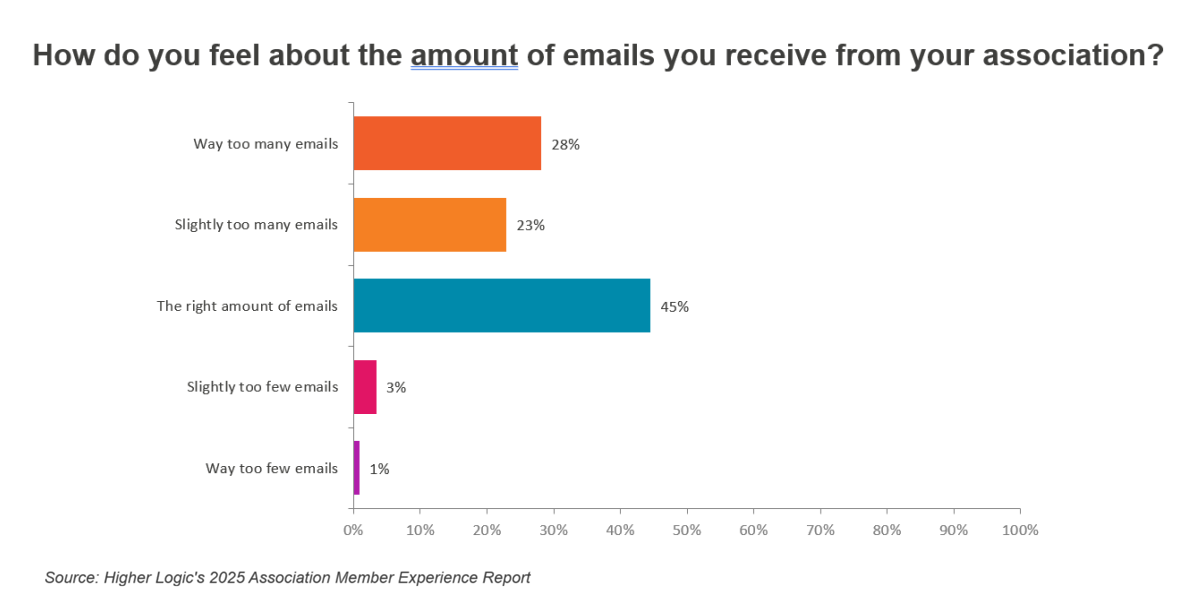
At the same time, there is growing pressure to communicate more intentionally. 51% of members say they receive too many messages, highlighting a challenge many organizations face: balancing visibility with relevance.
For association marketers, the implication is clear. Email continues to be a powerful channel, but sending more messages alone will not improve engagement. The organizations seeing the strongest performance are those that focus on delivering communications that are timely, targeted, and clearly tied to member value.
Clicks Are a More Reliable Email Engagement Metric
For years, open rates were the default metric for evaluating email success. While opens can still provide directional insight, they are becoming less reliable due to changes in how email platforms track engagement.
Privacy protections, email client changes, and automated image loading have made it increasingly difficult to determine whether an email was actually opened by a person. As a result, marketers are shifting their focus toward metrics that better reflect intentional engagement.
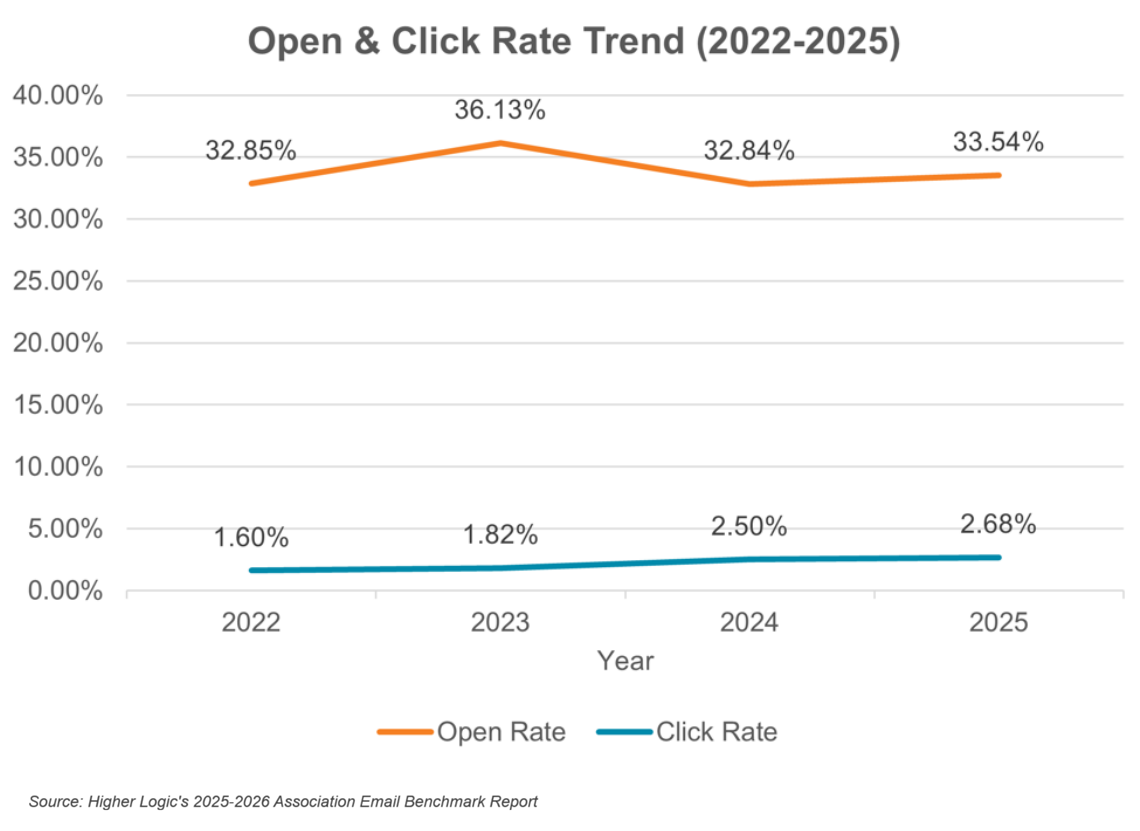
Across the benchmark data set, the average open rate for association emails was 33.54%, while the average click rate was 2.68%. More importantly, click rates have increased steadily from 2022 through 2025, even as inbox competition has grown.
Clicks represent meaningful action. When a member clicks through an email, they are choosing to learn more, register for an event, read a resource, or engage with their professional community.
That doesn’t mean open rates should be ignored entirely. They can still help identify trends over time. But for associations focused on understanding real engagement, metrics such as clicks, registrations, conversions, and participation provide a clearer picture of impact.
Relevance Beats Volume in Modern Association Email Strategy
Email volume across associations has steadily increased in recent years. From 2022 through 2025, the total number of emails sent continued to rise as organizations used email to support programs, events, and member communications.
However, the benchmark data reveals an important reality: engagement growth has not kept pace with the increase in email volume.
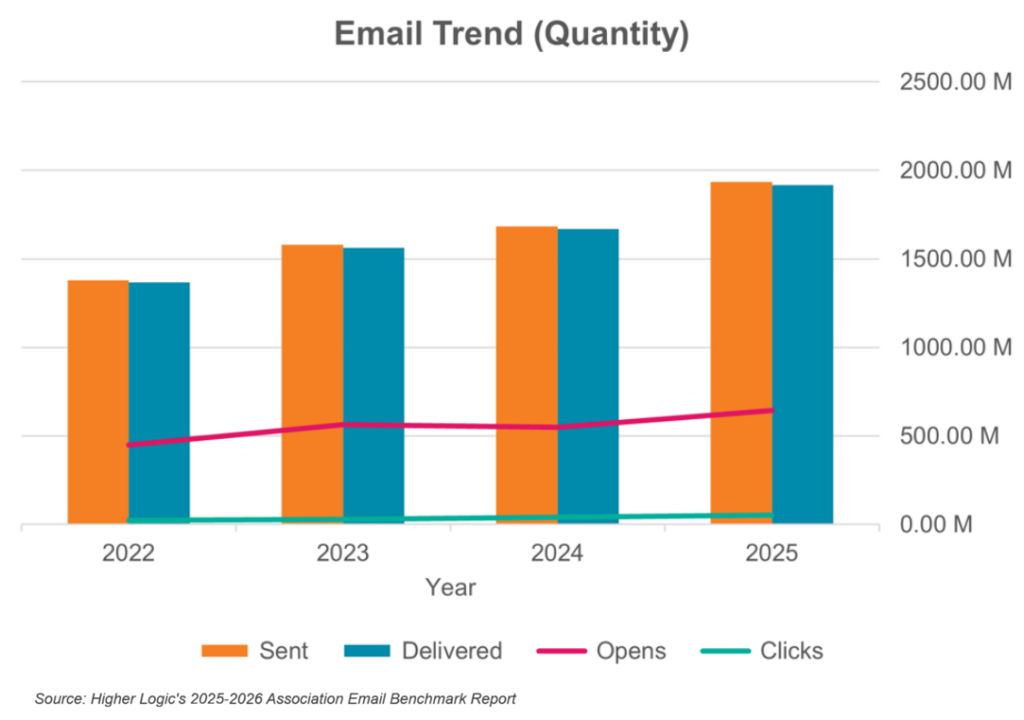
In other words, sending more emails does not automatically lead to more engagement.
Members are becoming more selective about which messages they open and interact with. As inboxes grow more crowded, recipients prioritize emails that clearly align with their interests, professional needs, or immediate priorities.
This shift reflects a broader change in digital communication. Successful email strategies are becoming quality-driven rather than volume-driven. Associations that focus on relevance—through segmentation, behavioral targeting, and thoughtful messaging—consistently see stronger performance than those relying on broad distribution.
Smaller, Targeted Email Sends Drive Significantly Higher Engagement
One of the clearest patterns in the benchmark report appears when looking at performance by send list size.
Emails sent to smaller, more targeted audiences consistently outperform large, untargeted sends.
For example, messages sent to lists of fewer than 500 contacts achieved open rates near 48% and click rates above 8%, dramatically higher than overall averages. As send list sizes increase, both open and click rates gradually decline.
This pattern does not mean associations should keep their overall audience small. Growth is still important. But it does highlight how critical segmentation is for maintaining engagement as organizations scale.
Even associations with very large databases can achieve strong results when they divide their audiences into smaller groups based on interests, professional roles, career stage, or engagement history.
When members receive communications that reflect their specific interests or needs, they are far more likely to pay attention—and take action.
Shorter Subject Lines Remain an Untapped Optimization Opportunity
Subject lines play a major role in whether an email is opened. They compete for attention in busy inboxes, often determining whether a recipient reads the message or scrolls past it.
The benchmark data reveals a consistent pattern: shorter subject lines tend to perform better.
Subject lines under nine characters produced the highest open rates, with those in the 20–39 character range also performing strongly. As subject lines grow longer, open rates gradually decline.
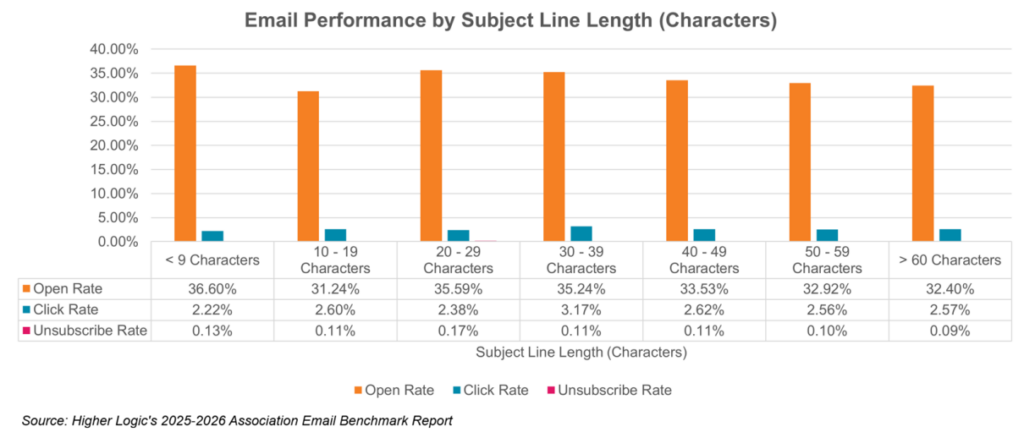
Despite this performance advantage, most association emails still use subject lines longer than 40 characters.
This gap represents one of the simplest opportunities for improvement. Testing shorter subject lines can often increase open rates without requiring additional technology, resources, or major workflow changes.
Associations experimenting with this approach often find that clarity and focus outperform attempts to explain too much within the subject line itself.
Marketing Automation and Personalization Deliver Stronger Results
Automation and personalization continue to be among the most effective ways associations can improve email performance.
Emails sent as part of automated campaigns consistently outperform one-time sends, achieving both higher open rates and significantly stronger click performance. These campaigns work because they deliver messages at moments when they are most relevant to the recipient.
Examples include:
- New member onboarding campaigns
- Event follow-up emails
- Renewal reminders
- Behavior-triggered communications after members attend events or interact with resources
Personalization further strengthens engagement. Segmented and personalized messages consistently outperform generic email blasts while maintaining low unsubscribe rates.
By aligning communication with member behavior, interests, or lifecycle stage, associations can deliver messaging that feels timely and relevant rather than intrusive.
Community Data Improves Personalization—and Email Performance
One of the biggest challenges associations face when personalizing communication is understanding what members actually care about.
Online communities provide valuable insight into this question.
When members participate in discussions, view content, or interact with peers inside a community platform, they generate behavioral signals that reveal their interests and professional priorities. This data can dramatically improve how associations segment audiences and tailor their communications.
Benchmark findings show that associations who integrate Higher Logic Thrive Community + Marketing achieve higher open and click rates than those using marketing tools alone.
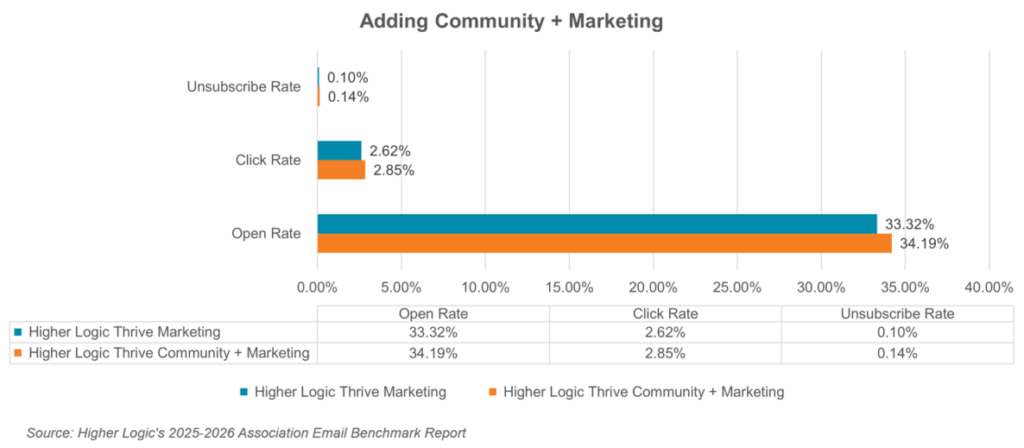
Community activity provides a deeper layer of insight than profile data alone. Instead of relying solely on demographic information or static membership records, organizations can personalize communication based on how members actually engage.
This behavioral context helps associations send fewer—but more relevant—messages while improving engagement across email programs.
What These Email Benchmarks Mean for Association Marketing Teams
Taken together, the findings from this year’s association email benchmarks highlight a broader shift in how successful organizations approach communication.
Email remains one of the most powerful engagement tools available to associations. But performance increasingly depends on how effectively organizations align their messaging with member behavior and expectations.
As associations refine their email strategies, several priorities stand out:
- Focus on relevance and segmentation rather than send volume
- Evaluate engagement using clicks, actions, and conversions—not just opens
- Use automation and behavioral triggers to deliver messages at the right moment
- Design emails that are mobile-friendly and accessible
- Continuously test subject lines, segmentation strategies, and timing
Ultimately, the organizations seeing the strongest results treat email as part of a broader member experience strategy, not simply a communication tool.
When email messaging reflects what members care about—and connects them to meaningful opportunities to learn, participate, and connect—it becomes far more than another message in the inbox. It becomes a driver of engagement, value, and long-term member relationships.
Related Resources
2025-2026 Association Email Benchmark Report
Explore the latest email performance benchmarks specifically for associations: open, click & unsubscribe rates, ideal subject lines, automation impact, segmentation...
Read More
What is Email Deliverability, Why Does it Matter, and How Can You Improve Yours?
Making sure your members open and engage with your emails requires you to balance a lot of factors. One of...
Read More
Marketing Automation Success Kit
Learn how to use marketing automation to streamline your work, improve personalization, and deepen member engagement.
Read More